Juliette's Learning Tribe
Dyspraxia at work: support for learning, step by step
Dyspraxia can make planning, sequencing and holding steps in your head hard work. How a tutor that goes one step at a time and keeps your place helps.
Dyspraxia is best known for affecting movement. At work, the steps in between can be just as hard. Planning a piece of work. Getting things in the right order. Holding three instructions in your head while you do the first one. Support for learning means one step at a time, with the plan where you can see it. And you should never have to remember where you were.
That’s how Zavmo teaches everybody. It doesn’t need to know you’re dyspraxic.
What dyspraxia is
Dyspraxia is also called developmental co-ordination disorder, or DCD. The NHS describes it as a condition you’re born with that mainly affects movement. It can also affect planning and organising your time, and learning new skills and remembering information. Typing is one of the finger tasks it names.
The Dyspraxia Foundation’s guide for employers is clear about the other side. It says adults with dyspraxia “routinely bring determination and innovation to the workplace”. It names persistence and hard work as characteristics associated with dyspraxia, and notes many people have strengths in original thinking.
What can make learning hard
The same guide lists organisation, memory, sequencing, concentration and time management as areas that can take extra effort. In its table of how dyspraxia may show up at work, one line stood out to me: “Difficulty planning and organising thoughts.”
Now think about a typical online course. A long page of instructions. Five steps to follow, explained once, at the top. A form to type into. A deadline to get it all done. Every one of those leans on exactly the things the guide lists.
This is where working memory comes in. Working memory is the part of your mind that holds something while you use it. A lesson that makes you carry the whole sequence while you do step one spends your effort on remembering. Not on learning.
I’ve built plenty of courses like that myself.
How Zavmo supports learning with dyspraxia
There is no dyspraxia mode in Zavmo, and no teacher for dyspraxia. That isn’t how it works. What helps one person on Tuesday might not help them on Thursday.
So we watch the lesson instead. A thirteenth agent, Agent 13, follows every lesson as it runs. It watches how you’re engaging and how much you’re being asked to carry at once. When an explanation isn’t landing, it brings in a different character and tells you why, in one line. Ask for an example or to go slower, and the teaching changes too.
Here’s what is on for everyone, mapped to what the guide describes:
- One step at a time. Every character is set up to answer in a few sentences, with one idea and one question at a time. You don’t have to hold the rest.
- The same four steps. Each part of a lesson runs the same way. Meet the idea, see it in practice, your turn, quick check. On a laptop, you can see which one you’re on.
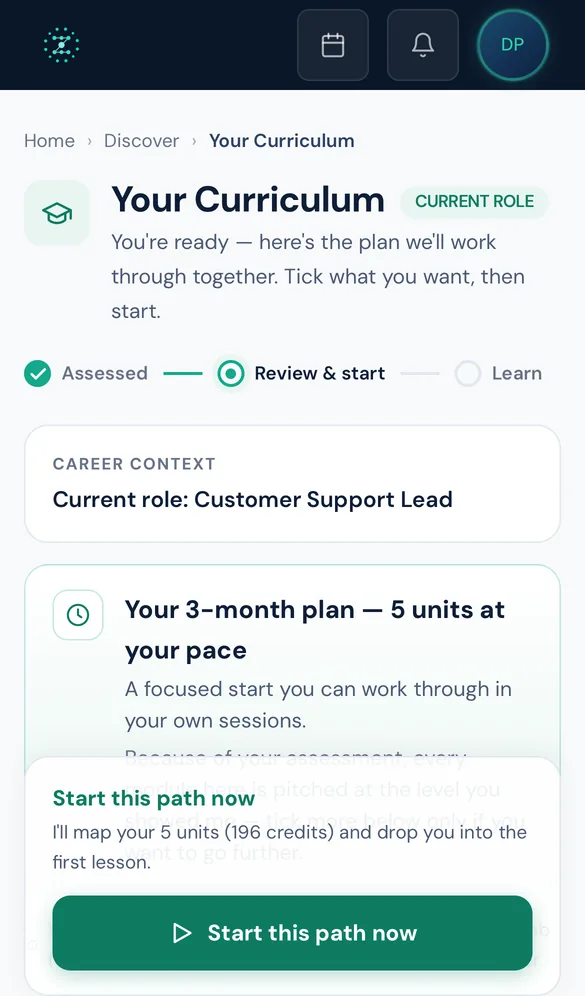
- Your plan is written down. Your plan has its own page, showing how many units, at your pace. You don’t have to keep the route in your head.
- Talk instead of type. If typing is slow or tiring, speak your answer. Tap Listen to hear any reply.
- Slower, and back to basics. Tap Slower please or I’m confused and the teaching changes. I’m confused brings in the Builder, one of the twelve characters, who lays the basics down solidly before anything goes on top. Make it easier is always in the tutor menu.
- Save and finish later. Stop whenever you like. Sessions can be as short as 5 to 10 minutes, so each one is small enough to finish.
- Pick up where you left off. Every lesson goes into a learning record in your name. The tutor remembers where you were so you don’t have to.
- Practice is never scored. Get the order wrong and try again. It doesn’t count against you.
Two examples
An illustrative example, not a real learner.
Learner: There are too many steps in this. I’ve lost where I am with the project timeline.
Zavmo: Let’s do just one. Step one is listing what has to be finished before the launch. I’ll keep the other steps. What’s the first thing on your list?
What changed: The learner tapped Slower please. The tutor stopped presenting the whole sequence and held it for them, so the only job was the next step.
An illustrative example, not a real learner.
Learner (speaking): So the handover is for Sam. He’s taking the budget while I’m off. He needs the supplier stuff, and the dates. Actually the most important bit is the two invoices still open.
Zavmo: That’s a good handover. You said the open invoices matter most, so they go first. Then the dates. Here’s your order so far, in three lines. Tap Listen if you’d rather hear it.
What changed: The learner used the microphone instead of typing. The tutor pulled the order out of a spoken answer and wrote it back in three lines. Nothing had to be held in mind.
The task didn’t get smaller. Everyone has to put a handover in the right order. This learner got there by speaking, one step at a time.
At work
If you’re dyspraxic, you have rights at work. This is what that means in practice, not legal advice.
- Acas explains that being neurodivergent will often count as a disability under the Equality Act 2010. That gives you the right to reasonable adjustments.
- Acas lists example adjustments such as visual planners, extra reminders, smaller task breakdowns and an easier-to-use keyboard or mouse.
- As of November 2026, Access to Work can help pay for things like assistive software and specialist equipment. It doesn’t pay for reasonable adjustments, which your employer must make.
Where it stops
Zavmo is not a diagnosis, and it is not a treatment. It won’t help with balance or handwriting, and it won’t tell you whether you’re dyspraxic.
The research on AI tutors for dyspraxic adults at work is thin. Most tutoring studies come from schools and universities. We haven’t published a study of our own.
But I love this bit. A tutor that carries the plan for you means all your effort goes on the learning. That used to need a person sitting next to you. Now it’s in your pocket.
Try it
Your first module, Future Fluency: AI skills for work, is free. No card needed. Start with a 5 to 10 minute session and speak your answers if that’s easier.
You can read how Zavmo works for different minds, or my wider piece on AI for neurodivergent learners. If numbers are the harder part for you, I’ve written about dyscalculia at work.