The Question a Course Never Asks
Most online courses show everybody the same screens in the same order. If screen four loses you, screen five arrives anyway.
A tutor stops and asks whether that landed. If it didn’t, it tries again, a different way. That one question is the whole idea.
What adapts
Six Things That Change While You Learn
The Explanation
If it hasn’t clicked, the tutor tries another way in. It might try a worked example, a story from your work, or smaller steps.
The Pace
It slows down when something is hard and moves on when you clearly know it. You don’t sit through what you can already do.
The Difficulty
It starts by checking you remember and understand. Then it asks you to use the idea on real work. It only climbs once you’re ready.
The Examples
Lessons use your role and your sector. A data analyst and a nurse get different examples for the same idea.
Who Is Teaching
Twelve teaching characters, each with its own way of explaining. When one isn’t working, Zavmo brings in another, mid-lesson.
The Check
It asks you to explain things back in your own words. That says far more than a multiple choice quiz.
You stay in control
Say When It Isn’t Working
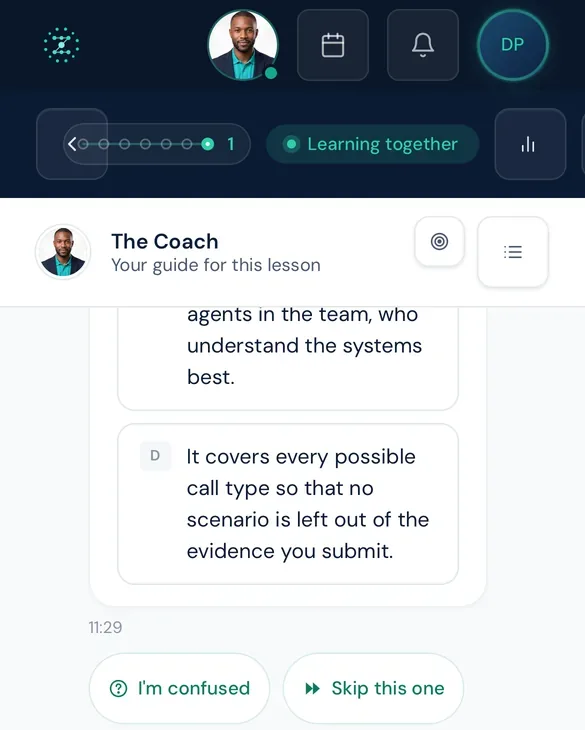
You don’t have to pretend you understand to keep going. One-tap buttons sit under each tutor message, such as I’m confused, Slower please and Show me an example. The teaching changes when you use them.
You can ask for a hint, or have any reply read aloud. You can talk instead of typing. Choose how long a session runs, from five minutes up to an hour, and save and finish later whenever you like.
What it is not
No Learning Styles. No Answers Handed Over.
Zavmo will never tell you you’re a “visual learner”. There is no good evidence that teaching to a learning style helps, so we don’t do it. It watches whether the explanation in front of you is working, and changes it if not.
It won’t hand you the answer either. You do the thinking, and it helps when you’re stuck. Practice is a safe place to get things wrong.
Why I built it
The Tutor I Wish I’d Had
I’m dyslexic. For most of my life, getting what was in my head onto a page either took forever or didn’t happen. Everybody got the same lesson at the same speed. If it didn’t fit how I thought, I worked around it.
Then I spent twenty years building learning technology. A lot of what our industry made, mine included, was built for the middle of the room and measured on who finished.
One to one tutoring has always worked better. In 1984 Benjamin Bloom found the average tutored student finished ahead of 98 per cent of a normal class. Nobody doubted that it works. Nobody could afford a tutor for everyone.
Now we can. I think it is the most exciting thing happening in learning, and I feel lucky to be building it.
Juliette Denny, founder of Zavmo
The research, and where it stops, is set out in is ChatGPT an adaptive tutor? and on the science page.

For teams
Give Everyone Their Own Tutor
Each person learns on their own job, at their own pace. Then you see what they can explain and use at work. Not just who finished.
Read more
Adaptive AI Tutors, Explained
Is ChatGPT an Adaptive Tutor?
What ChatGPT does well, what adapts in a real tutor, and five questions to test any tutor.
AI Tutor vs E-Learning
What changes for your staff, and when e-learning is still the right choice.
Rolling Out an AI Tutor to Your Team
One skill, a small group, two weeks. Then judge it on what people can do.
Questions About the Tutor
What Is an Adaptive AI Tutor?
It is a tutor that changes how it teaches while you learn. It checks what you understood. If something has not clicked, it explains it another way. When you are ready, it moves you on. A normal online course shows everyone the same screens in the same order.
Does Zavmo Sort Me Into a Learning Style?
No. A 2008 research review found no adequate evidence that teaching to a learning style helps. Zavmo watches something simpler. Is the explanation in front of you working? If not, the teaching changes.
How Much Time Does It Take?
As much or as little as you have. Lessons fit around a busy job, in short sessions you can pick up and put down. You set the pace.
What Does the Tutor Remember About Me?
It remembers what you are working on and what you find hard. That is how it adapts. You can see what it remembers about you in Settings. To change or delete it, email hello@zavmo.ai.
Do I Get A Real Qualification?
Zavmo is not an awarding body, so it does not hand you the certificate itself. What you build is evidence towards a qualification: your progress is recorded against the assessment criteria, mapped to what real qualifications cover. Before working towards an award, check with an approved centre what it will accept and arrange any separate assessment, fees and registration. A learning record does not award the qualification.
How It WorksTry it on your own work
Your First Module Is Free
It is Future Fluency: AI skills for work, practised on your own job.
Start FreeCreate a free account. No card needed. Your personal AI tutor is £70 a month, and you can cancel any time. See what the tutor does
More About Learning with Zavmo
- How Zavmo Works The whole method, in one page.
- The 4D Process Four steps, from where you are to where you want to be.
- The Twelve Characters Twelve ways of being taught, and how yours is chosen.
- The Mind Palace A memory you can walk through, built as you learn.
- The Saraswati Project The teaching model in development, and what comes next.
- Neurodiversity Built for the way your brain works, not around it.
- Qualifications and Standards How teaching, assessment and the final award fit together.
- Neurogogy The argument the whole method is built on.
- The Science The evidence, with the papers named.
- See a Lesson Real lesson screens, with the details explained.