Juliette's Learning Tribe
Is ChatGPT an adaptive tutor? What a real AI tutor does differently
ChatGPT can tutor you if you ask it to. An adaptive AI tutor does it without being asked: it checks you understood, tries another way, and moves you on.
Sort of. ChatGPT can tutor you, and it can be very good at it, but only if you steer it. An adaptive AI tutor does the steering for you. It checks what you understand. When something hasn’t clicked, it explains it a different way. When you’re ready, it moves you on.
A normal online course does none of that. Everybody gets the same screens in the same order, then a quiz at the end.
What ChatGPT does well, and where it stops
I use AI every single day, and I love it. Ask ChatGPT to explain something and it will, in seconds, as many times as you like.
In July 2025 OpenAI added a study mode that asks you questions and gives hints instead of handing over the answer. That is a real step towards tutoring.
But it still waits for you. You have to know what to ask, notice when you have not understood, and keep the plan in your head. It does not know your job unless you tell it, every time. And one click takes you back to the answer machine.
That is fine when you already know what you are learning. It is hard when you don’t, which is most of the time when you are learning something new.
So the difference is who drives. With ChatGPT, you do. With an adaptive tutor, the tutor does, and it hands you the wheel whenever you want it.
I have been building learning technology for twenty years. I know how that second kind gets made, because I made plenty of it.
Why one-to-one teaching was always the best
In 1984 an education researcher called Benjamin Bloom published a paper with a strange title: The 2 sigma problem.
He compared students taught in a class of about thirty with students taught one to one by a tutor. The average tutored student finished ahead of 98 per cent of the class.
Everybody knew tutoring worked. The problem was the bill. You cannot give every learner their own tutor, so we built classrooms, and later e-learning. Both are aimed at the middle of the room.
Later research brought Bloom’s number down to earth. A 2011 review by Kurt VanLehn put the gain from human tutoring lower, at about 0.79 of a standard deviation. That is still a big effect.
The surprise was the other finding. Well-built computer tutors that worked step by step came close, at about 0.76.
That was before large language models. Now a tutor can hold a real conversation with you about your actual job. For most of my career, a tutor for everybody was a lovely idea nobody could pay for. Now it is a thing you can open on your phone, and I still find that astonishing.
What actually adapts
“Adaptive” gets stuck on a lot of things that don’t deserve it. A course that skips a module because you passed a quiz is not much of a tutor. These are the things that should change while you learn.
The explanation. If you don’t get it, the tutor tries another way in. Maybe a worked example, or a story from your kind of work. Sometimes it goes back a step before it presses on.
The pace. It slows down when you’re struggling and speeds up when you clearly know it. Nobody should sit through ten minutes on something they can already do.
The difficulty. It starts by checking you remember and understand. Then it asks you to use the idea on real work. Later, you build something of your own with it. It only climbs once you’ve shown you can.
The examples. A data analyst and a nurse need different examples for the same idea. A good tutor uses your role and your sector, so you practise on the work you actually do.
The check. It asks you to explain things back in your own words. Getting a multiple choice question right is not the same as understanding it.
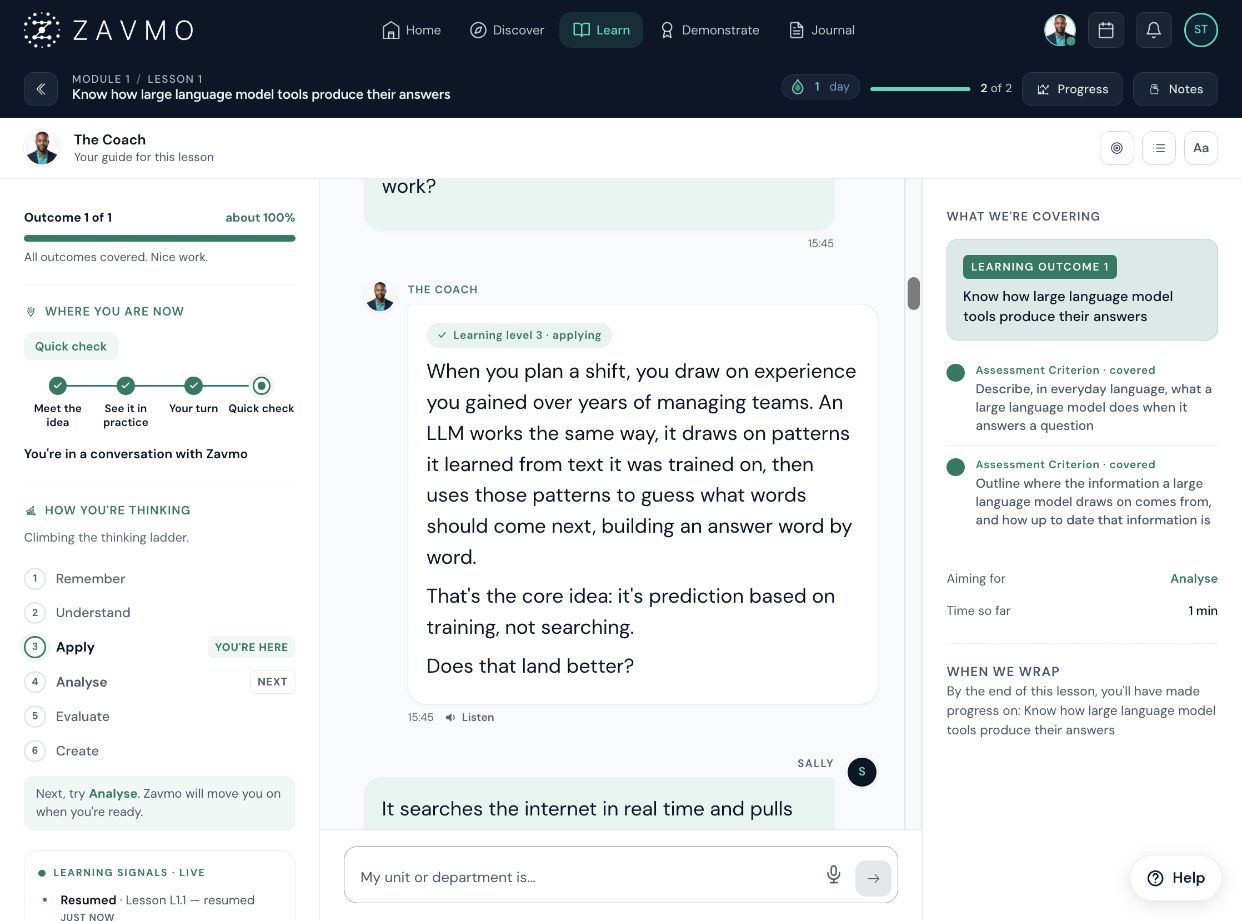
That is a real Zavmo lesson. The first explanation hadn’t landed. So the tutor didn’t say it again, louder. It tried again with planning shifts, something the learner knew from years of managing a team. Then it asked whether that landed better.
That one question is the whole idea. A course with fixed screens can’t ask it.
What an adaptive tutor is not
Not learning styles. Nobody is a “visual learner” in a way that changes how they should be taught. A 2008 review by Pashler and colleagues found no adequate evidence for it. A tutor that sorts you into a type at sign-up and teaches to it is selling you a myth.
What it should watch is much simpler. Is this explanation working for you, right now? If not, change it.
Not a chatbot that hands you the answer. That feels helpful and teaches you nothing. A good tutor makes you do the thinking, and helps when you’re stuck.
Not a way of marking you for your boss. Practice should be a safe place to get things wrong. If every wrong answer counts against you, you stop trying anything difficult. I would.
How to tell if an AI tutor is really adaptive
Try it for ten minutes. Then ask yourself five things.
- Did it check what I already knew before teaching me?
- When I got something wrong, did it explain it differently, or just repeat itself?
- Did it use examples from my kind of work?
- Could I tell it I was confused, or ask it to slow down?
- Can I see what it remembers about me, and change it?
If most of the answers are no, you are using a course with a chat box stuck on the side.
What the evidence says, and where it stops
Most of the research on tutoring comes from schools and universities. Very little comes from workplaces. If you’re choosing something for your team, that matters.
The study that excites me most is from Harvard. In 2025, Kestin and colleagues ran a randomised trial in an introductory physics course with 194 students. Students using a carefully designed AI tutor learned more than those in a well-run active learning class. Their median learning gain was over double, in less time.
The authors are careful about it, and so am I. It was one course at one university. The tutor was built with care. It guided students through each step and worked from answers the teachers had written. The authors say plainly that AI tutoring will not always win.
So a well-designed tutor can be very good. That does not make every chatbot a tutor.
What I built, and why
I’m dyslexic. For most of my life, getting what was in my head onto a page either took forever or didn’t happen. Everybody got the same lesson at the same speed. If it didn’t fit how your brain worked, that was your problem. I learnt to work around it.
Zavmo is the tutor I wish I’d had.
ChatGPT isn’t an adaptive tutor. It doesn’t know how people learn. It doesn’t know the course, what it’s meant to teach, or how you’ll be assessed. It isn’t watching whether you’re interested in the content. And mostly it gives you the answer, instead of helping you work it out. That matters most. Being handed the answer is not the point of education.
It has twelve teaching characters, each with its own way of explaining. When one isn’t working, Zavmo brings in another, in the middle of the lesson. You can say you’re confused, ask for a hint or have a reply read to you. You can talk instead of typing. You choose how long a session runs, from five minutes up to an hour, so it fits around a real job.
It is built around your work, too. You start with your role, or the role you want, and the lessons use it.
Your first module, Future Fluency: AI skills for work, is free. No card needed. Try it, then run the five questions above on it. I’d love to know what you find.