Juliette's Learning Tribe
Is an AI tutor worth it for adults learning around a job?
An AI tutor is worth it if you want to get better at your own work and will use it each week. What it costs, and when it is not worth it.
Is an AI tutor worth it? For an adult learning around a job, yes, if two things are true. You want to get better at something in your actual work. And you will open it a few times a week, even for ten minutes.
If neither is true, keep your money.
Zavmo costs £70 a month and you can cancel any time. Your first module is free, with no card. So you can find out which kind of learner you are before you pay anything.
What you are paying for
Most online courses are the same screens for everybody, in the same order. I know, because I built a lot of them. They were made for the middle of the room and measured on whether people finished.
A tutor should be the opposite. It checks what you already know. It explains something, then asks you to explain it back. When it hasn’t clicked, it tries another way in. When you clearly have it, it moves you on.
That is the thing worth paying for. Not the content. Content is everywhere, and most of it is free. You are paying for something that notices when you’re lost.
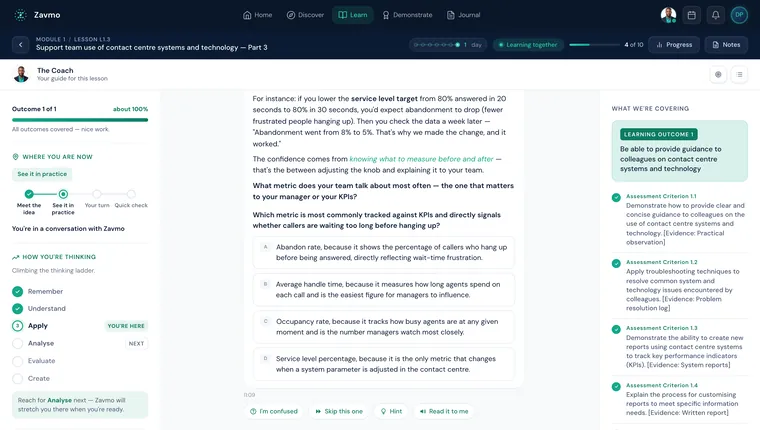
That lesson is for someone who leads a contact centre team. The example is a service level target from her own kind of work, not a textbook. Under the question sit four buttons: I’m confused, Skip this one, Hint and Read it to me.
What the research says, and where it stops
One-to-one tutoring has one of the best records in education research. A 2011 review by Kurt VanLehn put the gain from human tutoring at about 0.79 of a standard deviation. Well-built computer tutors that worked step by step came close, at about 0.76.
In 2025 a Harvard team led by Gregory Kestin ran a randomised trial in a physics course. Students using a carefully designed AI tutor learned more, in less time, than students in a well-run active learning class.
I find that thrilling. For most of my career a tutor for everybody was a lovely idea nobody could pay for. Now it fits in your pocket.
But look at where it stops. Both studies come from schools and universities, not workplaces. The Harvard trial was one course with 194 students. Its tutor worked from answers the teachers had written. A chatbot with a friendly name is not that.
So the evidence says a well-built tutor can be very good. It does not say every AI tutor is.
When an AI tutor is worth it
- You are learning for your job, not for a test. Zavmo’s lessons use your role and your sector, so you practise on the work you do.
- You learn in gaps. A session can be as short as five minutes. Save and finish later keeps your place.
- You have been lost in a course before, with nobody to ask. Here you can tap I’m confused, ask it to go slower, or ask for an example. The teaching changes when you do.
- You want to get things wrong in private. Practice is not scored. Nobody is marking you.
- The skill is moving fast. AI at work is the obvious one. A course recorded last year is already behind.
When it is not worth it
An AI tutor only works if you turn up. It will not chase you the way a good teacher would. £70 a month for something you open twice is a bad deal, and I’d rather you didn’t pay for that.
It is also the wrong tool in a few cases.
- You need a qualification certificate. A tutor can help you learn the material. But each qualification has its own entry and assessment rules, and Zavmo does not award qualifications.
- You need one fact, once. Search is free.
- You need proof everybody saw a policy. Plain e-learning does that job fine, and it’s cheaper.
And large language models make mistakes. A good tutor checks what you understood rather than just chatting. You should still question what it tells you. That habit is half of learning AI anyway.
An AI tutor is money well spent, because it’s personal to your role. You can use what you learn straight away. You can practise on case studies and role plays, and that builds confidence. Especially if you’re moving from one role to another. It can be a lot more efficient than e-learning.
How much do AI tutors cost?
Prices vary a lot, and plenty of AI tools have a free version. I’m not going to quote other companies’ prices. They change, and you should check them yourself.
Here is ours, as of November 2026. Teaching with Zavmo is £70 a month, billed monthly, cancel any time. Searching UK roles and qualifications and planning your route are free. Your first Future Fluency module is free, with no card. It’s all on the pricing page.
The way I’d judge any of them is cost per use. If you learn most days, £70 a month works out at about £2.30 a day. If you use it twice a month, it’s expensive.
Test it before you pay
Use the free module as your trial. Ten minutes, three times in one week. Then ask yourself four things.
- Did it check what I already knew?
- When I got something wrong, did it explain it a different way?
- Did the examples come from my kind of work?
- Did I come back without being nagged?
If the answer to the last one is no, don’t pay. If it’s yes, you have your answer.
There is a longer checklist in what an adaptive AI tutor is. And how the Zavmo tutor adapts shows it working, screen by screen.
Start with Future Fluency: AI skills for work. The first module is free.