Juliette's Learning Tribe
ADHD and learning at work: how an AI tutor can help
ADHD can make long courses hard to start and harder to finish. How a tutor that works in short turns and changes its approach mid-lesson can help.
An AI tutor can help with ADHD at work in three ways. It keeps every turn short. It lets you stop and start without losing your place. And it changes its approach the moment the lesson stops holding you. Zavmo does all three, for everyone, and it never needs to know you have ADHD.
I’m dyslexic, not ADHD, so I won’t tell you what ADHD feels like. Plenty of people with ADHD have said it far better than I could, and I’ve linked to them below. What I can tell you is what we built, and why.
What ADHD is
ADHD stands for attention deficit hyperactivity disorder. The NHS describes it as a condition that can affect how you focus. In adults, signs include being easily distracted or forgetful, finding it hard to organise your time, and having a lot of energy or feeling restless.
That is only half of it. In 2025, researchers from the University of Bath, King’s College London and Radboud University compared 200 adults with ADHD with 200 without. Their study found the adults with ADHD were more likely to strongly identify with strengths including hyperfocus, creativity, humour and spontaneity. Using those strengths went with better wellbeing.
What can make learning hard
Most training at work asks for the exact things ADHD can make hard. Read a lot. Sit still for forty minutes. Remember where you got to last Tuesday. Go back and finish it.
The NHS lists “finding it hard to follow instructions or finish tasks” among the signs in adults. A long course with one fixed path, a wall of text and a quiz at the end is built to trip that up. I know, because I built a lot of them.
Then there’s the other side. When something grabs you, hyperfocus can carry you a long way. So the question I care about is simple. Does the teaching keep hold of you, and does it notice when it hasn’t?
How Zavmo supports learning with ADHD
We don’t have an ADHD mode, and we don’t have a teacher for ADHD. I don’t think that’s how it works. Two people with the same diagnosis can need completely different things on the same afternoon.
What we have instead is Agent 13. It doesn’t teach. It watches every lesson while it runs. How you’re engaging, what holds your interest, what loses it, and how much you’re carrying at once. When a way in stops working, it brings in a different teacher from our twelve characters: a gentler one, or one who stretches you more. It tells you why, in one line. Ask for an example, or to go back a step, and the teaching changes too.
Everything below is on for everybody. It happens to help with a lot of what people with ADHD describe.
- Short turns, one idea at a time. Every character is set up to answer in a few sentences. There’s no wall of text between you and the question.
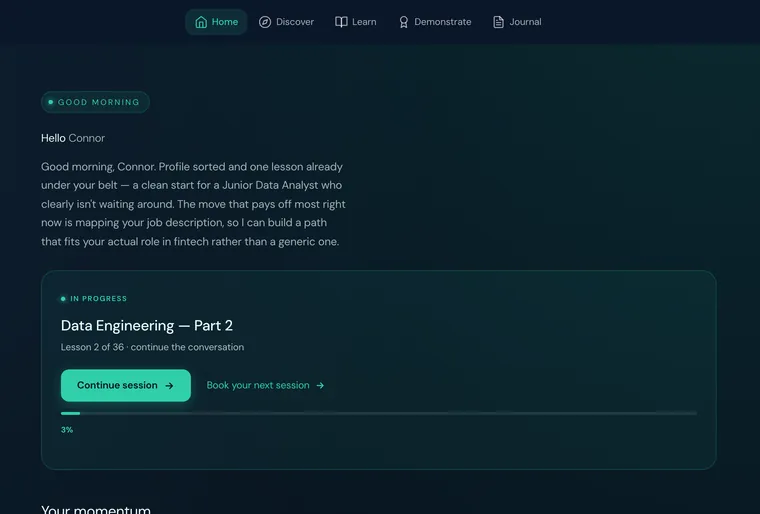
- Your session length. Choose from 5 to 10 minutes up to an hour. A short one fits between two meetings.
- Save and finish later. Stop in the middle of a lesson. Your place is kept.
- Pick up where you left off. Every lesson goes into a learning record in your name. The tutor starts from where you stopped, even after a fortnight away.
- Talk instead of type. Speak your answer if that’s quicker than typing it. Tap Listen to hear any reply read aloud.
- Say when it’s dragging. One-tap buttons sit under each tutor message. Under an explanation you’ll see Slower please and Show me an example. Under a question, I’m confused, Skip this one and Hint.
- Practice is never scored. Throw out a half-formed answer. Getting it wrong costs you nothing.
We were running AI Fluency with a group of tech people, and it wasn’t working. They felt they already knew it. So the approach changed, to a teacher who works from practical examples. They started describing their own projects. Once they were in the flow of that, they could see the point of the lessons.
Two examples
An illustrative example, not a real learner.
Learner: Sorry. I started this last week and I’ve completely lost the thread.
Zavmo: No problem. Last time you were checking an AI draft of your quarterly report. You’d found one figure that didn’t match your spreadsheet. Shall we carry on from there, or have a one-minute recap first?
What changed: Nothing had to be redone. The learning record held the place, so the lesson restarted at the exact step, in a ten-minute slot.
An illustrative example, not a real learner.
Learner: Can we skip the theory? I just need to get my handover notes done before Friday.
Zavmo: Fair enough. I’m going to switch to a case study, and your handover is the case. Tell me in one sentence who’s picking it up and what they need to know first.
What changed: The learner asked, so the tutor dropped the definitions and used their own task. Their answers had been getting shorter, too. That is the kind of thing Agent 13 watches for.
The goal didn’t move. Only the way in did, and that is true for every learner.
At work
If you have ADHD, you have rights at work. This is what it means in practice, not legal advice.
- Acas explains that being neurodivergent will often count as a disability under the Equality Act 2010. That gives you the right to reasonable adjustments.
- Acas lists example adjustments such as regular breaks, a quiet place to work and smaller task breakdowns.
- ADHD UK publishes a pack for employers, with ideas for workplace adjustments.
- As of November 2026, Access to Work can help pay for support if you have a condition or disability. It doesn’t pay for reasonable adjustments, which your employer must make.
Where it stops
Zavmo is not a diagnosis, and it is not a treatment. It won’t tell you whether you have ADHD. If you think you might, the NHS page on ADHD in adults is the place to start.
The research on AI tutors for neurodivergent adults at work is still thin. Most tutoring studies come from schools and universities. We haven’t published a study of our own yet.
I still find this part thrilling. For most of my career, a course could not notice it had lost you. Now a tutor can notice in the same minute, and try something else.
Try it
Your first module, Future Fluency: AI skills for work, is free. No card needed. Try a 5 to 10 minute session and press Skip this one as often as you like.
You can read how Zavmo works for different minds, or my wider piece on AI for neurodivergent learners. If planning and sequencing are the harder part for you, I’ve also written about dyspraxia at work.