Juliette's Learning Tribe
AI for neurodivergent learners: how an adaptive tutor helps
An adaptive AI tutor changes the teaching, not the learner. Short turns, talk instead of type, a new way in when something hasn't landed. No diagnosis needed.
An adaptive AI tutor helps neurodivergent learners by changing the teaching, not the learner. It teaches in short turns. You can talk instead of typing. When an explanation isn’t landing, it tries a different way in. And it never needs to know your diagnosis to do any of that.
I’m dyslexic. I have spent my whole life being taught in ways that didn’t fit how my brain works, then finding my own way round. That is why this matters to me more than almost anything we build.
Fact after fact after fact loses me. I find it really hard to hold on to. Wrap the same facts around a real person, or something I care about, or one of my hobbies, and they stick.
Neurodiversity is normal, and so is struggling with bad teaching
Acas describes neurodiversity as the natural differences in how people’s brains process information. ADHD, autism, dyslexia, dyspraxia, dyscalculia and Tourette’s are some of the best known.
Most training was never built for any of that. It was built for the middle of the room. A wall of text. A fixed pace. One explanation, then a quiz.
That design is hard for everybody. For a lot of neurodivergent people it is a wall.
We don’t give you a teacher for your diagnosis
People ask me whether Zavmo has a teacher for ADHD, or one for dyslexia. It doesn’t, and it won’t. I don’t think that’s how it works.
Matching a teaching style to a label is the learning styles idea with a diagnosis attached. A 2008 review by Pashler and colleagues found no adequate evidence that teaching to a person’s “style” helps. Two people with the same diagnosis can need completely different things on the same afternoon.
So Zavmo watches something simpler. Is this explanation working for you, right now? If it isn’t, the teaching changes.
What changes, and when
Zavmo has twelve teaching characters. Each one explains things differently. The Builder lays foundations. The Analyst goes step by step, in detail. The Practitioner shows rather than tells. The Connector teaches through stories and real examples.

There is also a thirteenth agent, and it doesn’t teach at all. We call it Agent 13. Its job is to watch the lesson while it runs: how you’re engaging, what holds your interest, what loses it, and how much you’re being asked to carry at once.
When a way in stops working, Agent 13 brings in a different teacher. It might be a gentler one, or one who stretches you more. It tells you why, in one line, so nothing changes behind your back. Prefer the teacher you had? Pick them in Change tutor, and it stops switching for that lesson.
I gave the team one line for what Agent 13 is for. Maximum progress, in a way the learner enjoys. Both halves matter. Progress you hate doesn’t last.
Watching the load the whole time
There is a well-known idea in learning research called cognitive load. John Sweller set it out in a 1988 paper. Your working memory can only hold so much at once. Pile on too much and nothing goes in.
For a lot of neurodivergent learners, that limit arrives sooner, or on a different day than expected. So the tutor is set up to keep the load down for everybody:
- Short replies. Every character answers in a few sentences, one idea at a time. No walls of text.
- Talk or listen. Speak your answer instead of typing it. Tap Listen to have any reply read aloud.
- Your session length. Choose from 5 to 10 minutes up to an hour. Tap Save and finish later whenever you like.
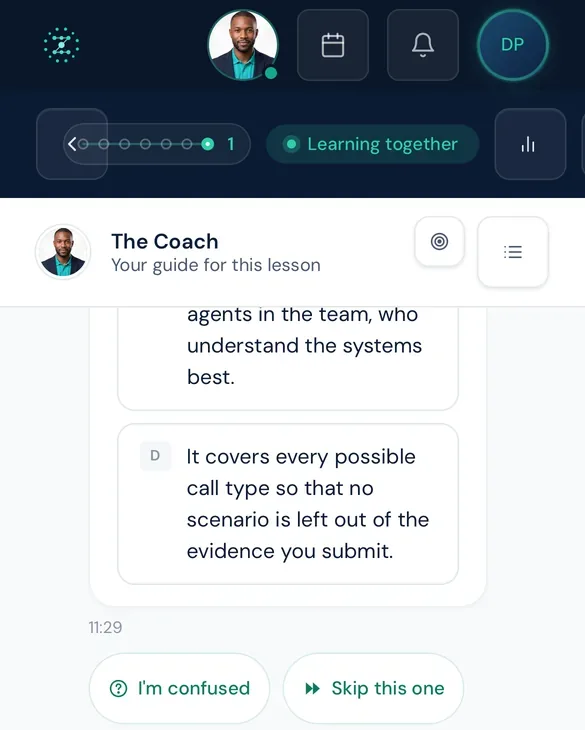
- Say how it’s going. One-tap buttons sit under each tutor message, such as I’m confused, Slower please, Show me an example and Hint. Which ones you see depends on the message. Use them and the teaching changes.
- Nothing scored in practice. Getting it wrong is how learning works, so practice never counts against you.
None of this needs a diagnosis. None of it is a treatment. It’s just on, for everybody.
What adapts is the route, never the finish line. Everyone learning to check an AI draft has to check it against other sources. How you get good at that is what changes.
Staying on track without the nagging
Motivation is often the real problem. You start well, life gets in the way, and the course sits there making you feel guilty.
Every lesson in Zavmo is written to a learning record in your name. It holds what you covered, which outcomes you worked on and how far up the thinking ladder you climbed, from remembering to creating. If you work in learning, you’ll know the standard behind it as xAPI.
That record is what lets the tutor pick up exactly where you left off, even after two weeks away. You never start again from the beginning. It also means progress is something you can see, not something you have to take on trust. For a lot of people that is the thing that brings them back.
It’s yours, too. You can see what Zavmo remembers about you in Settings. To change or delete it, email hello@zavmo.ai.
Built on real qualification outcomes
When you study towards a qualification, the lessons are built on that qualification’s own learning outcomes and assessment criteria. These are the published units of Ofqual-regulated qualifications, word for word, with nothing renamed. The tutor adapts how it teaches. It never changes what the qualification asks you to show.
Zavmo is not an awarding body, and learning with the tutor does not earn an award on its own. Each qualification has its own assessment rules. Future Fluency: AI skills for work is our own course and not a regulated qualification. Its first module is free.
Where this stops
An AI tutor is not a replacement for support at work. If you’re neurodivergent, Acas notes that this will often count as a disability under the Equality Act 2010, which means you can ask for reasonable adjustments. Access to Work can help pay for support.
The research on AI tutors for neurodivergent adults at work is still thin. Most tutoring studies come from schools and universities. We haven’t published a study of our own yet. I’d rather say that plainly than pretend otherwise.
For employers
The Buckland Review of Autism Employment, published in February 2024, set out 19 recommendations for helping autistic people start, stay and succeed in work. Several are about how workplaces are designed, not about fixing people.
Learning is part of that design. If your training only works for the middle of the room, it is quietly excluding a lot of your best people. A tutor that changes the teaching, rather than asking the learner to change, is one of the simplest fixes there is.
I find that exciting. For most of my career this kind of teaching cost a fortune, so almost nobody got it. Now everyone can.
Try it
Your first module, Future Fluency: AI skills for work, is free. No card needed. Tap I’m confused as often as you like. That’s what it’s there for.
You can read more about how Zavmo works for different minds, meet the twelve characters, or see how the adaptive AI tutor works. If you are dyslexic like me, I have written about what has worked for me.