Juliette's Learning Tribe
An AI tutor that talks back, for when typing is the hard part
Zavmo is an AI tutor you can talk to. Speak your answer instead of typing, and tap Listen to hear any reply. Why learning out loud works.
Yes, there are AI tutors that talk to you, and Zavmo is one. You can speak your answer instead of typing it. Tap Listen and any reply is read out loud. Each teaching character answers in a few sentences, one idea at a time, so it feels like a conversation rather than a wall of text.
That matters more than it sounds. For a lot of people, the hard part of learning was never the thinking. It was the typing and the reading.
Why this one matters to me
I’m dyslexic. For most of my life, getting what was in my head onto a page either took forever or didn’t happen.
Talking was never the problem. The page was.
Claude changed that for me. It let me flourish. So when we built Zavmo, I wanted a tutor you could simply talk to. I’ve written more about that in AI and dyslexia at work.
The difference is that Zavmo knows where you’re going. It knows what each unit is meant to teach and how you’ll be assessed on it. A general AI doesn’t know the end goal. It doesn’t know your job description, or the qualification you’re working towards. So Zavmo doesn’t wait to be asked. It asks the questions. It keeps an eye on how the conversation is going and on the quality of your answers. It checks you’re not carrying too much, or too little, for the learning to be useful. And it checks you’re engaged.
Saying it out loud is how you find the gap
There is good research on why explaining helps you learn.
In 1989 Michelene Chi and her colleagues watched physics students study worked examples. The students who explained the steps to themselves learned more than the ones who just read them.
Five years later Chi tested it directly, with a new team. Fourteen students aged 13 and 14 read a text about the heart and blood, and were asked to explain each line to themselves. Ten more read the same text twice. The explainers understood more. Every one of the students who explained the most ended up with the right picture of how the circulatory system works.
It is a small study, with children, on one science text. It was not done at work. But it matches every good learning moment I can remember. Rereading feels like learning. Explaining is learning.
And explaining is much easier out loud. Typing a paragraph about something you half understand is slow and painful. Saying it takes thirty seconds. When you talk, the gap shows up in the middle of the sentence. You get to “and then it…” and stop.
That stop is the useful bit. A good tutor hears it and picks it up from there.
How talking works in a Zavmo lesson
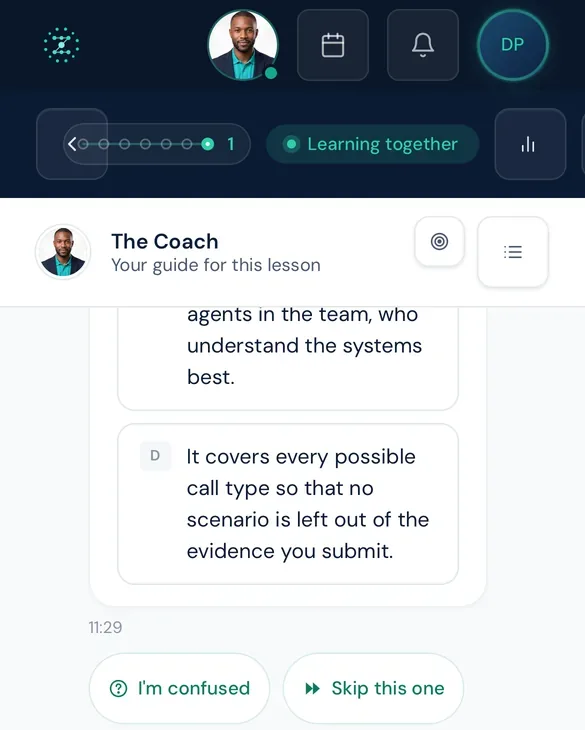
- Talk instead of typing. Where your browser supports it, tap the microphone in the answer box and say what you think. It asks your permission the first time.
- Listen to any reply. Tap Listen, or Read it to me, and the tutor’s reply is read aloud. Your eyes get a rest.
- Short turns. Every character is set up to answer in a few sentences. One idea, then it’s your turn again.
- Say when it isn’t working. One-tap buttons sit under each tutor message, such as I’m confused, Slower please, Skip this one and Hint. Which ones you see depends on the message.
- Keep it short. Choose from 5 to 10 minutes up to an hour. Save and finish later keeps your place.
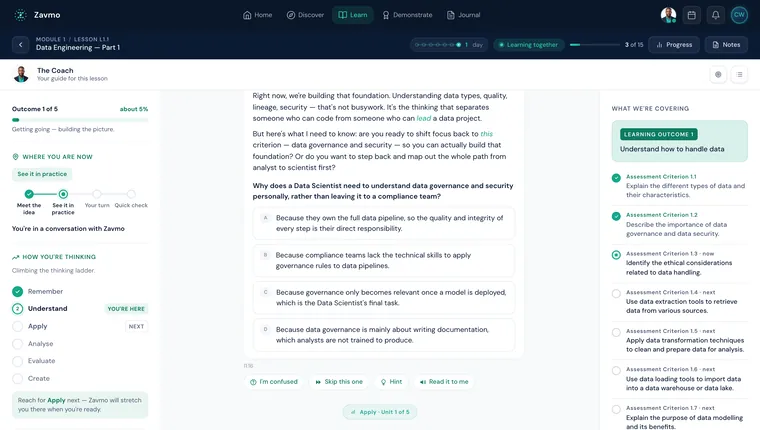
Practice is not scored, either. You can say something half-formed and wrong, out loud, and nothing counts against you. That is often exactly when you learn most.
Who it helps
Anyone who thinks faster than they type. Anyone who finds a long reply on a screen tiring by the end of the day. And a lot of people who would never call it a difficulty at all.
Hearing things as well as reading them is ordinary good practice. The British Dyslexia Association’s advice to employers includes giving verbal as well as written instructions, and considering text to speech software. A tutor that talks builds that in from the start.
You can read more about how Zavmo works for different brains on the neurodiversity page.
Where talking falls down
Talking out loud in an open-plan office is awkward. Most people won’t do it, and I don’t blame them. Headphones for Listen help, and typing is always still there.
Speech recognition also mishears things. Names, acronyms and the jargon of your job are the usual casualties. If the tutor’s reply seems to answer a different question, it probably heard a different one. Say it again, a bit slower.
Neither is a reason not to try it. They are reasons to try it somewhere you can talk.
Try it with your own voice
Find ten minutes somewhere quiet. Open the free first module of Future Fluency: AI skills for work. Answer every question out loud, and tap Listen on every reply.
Then notice how much further you got than you would have by typing. See how the Zavmo tutor adapts while you talk.