Juliette's Learning Tribe
Can AI help with dyslexia at work? What has worked for me
Yes, AI can help with dyslexia at work. It is not a treatment. It helps you get ideas onto the page and take long text in. What to try, and your rights.
Yes. For me, AI is the biggest change to working with dyslexia I have ever had. It is not a treatment, and it does not make dyslexia go away. It gets what is in my head onto the page, and it helps me take in long text without being worn out by it.
I am 54 and dyslexic. For most of my working life, writing either took me a very long time or did not happen at all. The ideas were there. Getting them onto a page was the wall.
Claude changed that. It let me flourish. I built Zavmo because it is the platform I wish I had had growing up.
My mind makes connections through examples. So when I needed to explain learning theory, and how Zavmo writes a record of each step so every lesson does the most good, I didn’t start with the theory. I started with a marathon. Claude helped me get it onto the page.
What dyslexia is
The NHS calls dyslexia a common learning difficulty where your brain works differently to most people. It says plainly that it does not affect intelligence.
The British Dyslexia Association says it mainly affects reading and writing, and is really about how information is processed.
Every dyslexic person is different. Two of us can need completely different things on the same afternoon.
What makes work hard
The things people describe are the ones workplace adjustments are written for. A long document before a meeting. Taking notes while somebody talks. Instructions that only exist in writing. A timed test. An e-learning module that is one wall of text after another.
None of that is about being able to do the job. It is about the way the job hands you information.
What AI is good at
These are the things worth trying first.
- Talk instead of typing. Say the messy version out loud and ask for it written up.
- Ask for order. Paste your notes and ask it to put them in a sensible sequence.
- Ask for shorter. Give it a long email or policy and ask what it says in five lines.
- Listen back. Have the answer read aloud before you trust it.
Use only the tools your employer has approved, and keep personal details out. I wrote about using ChatGPT safely at work.
The weak spot
Checking is reading. That is the catch.
AI sounds just as sure when it is wrong. Somebody still has to check the draft, and that is the part that is hard work for a dyslexic person. Listening to it read aloud helps a lot.
It can also smooth your writing until it sounds like somebody else. Tell it to keep your words. Your voice is worth keeping.
What software helps people with dyslexia at work?
Acas lists software to support reading or writing, such as a screen reader or a speech-to-text programme. It also lists more time, and instructions broken into clear steps. AI tools sit next to those. They do not replace them.
Your rights, in two lines
Reasonable adjustments. Acas says a worker does not need a diagnosis to be considered disabled under the Equality Act 2010. Employers should offer support either way.
Access to Work. As of November 2026, the gov.uk eligibility page lists ADHD and dyslexia and says you do not need a diagnosis to apply. It covers people who live and work in England, Scotland or Wales. In May the government said it was hiring staff to clear a backlog and considering wider reforms, so check the page before you apply.
This is what it means in practice, not legal advice.
How Zavmo supports you
Everything here is on for everybody. Nothing needs a diagnosis, and none of it needs asking for.
- Short replies, one idea at a time. No wall of text.
- Talk instead of typing.
- Listen reads any reply aloud.
- Sessions from 5 to 10 minutes up to an hour.
- Save and finish later keeps your place.
- One-tap buttons under each tutor message, such as I’m confused, Slower please and Show me an example. The teaching changes when you use them.
- Hint, when you want a nudge rather than the answer.
- When something is not landing, Zavmo changes the approach or brings in a different teacher, and it tells you it has.
- Practice is never scored.
- Your learning record, so you pick up where you left off.
If you want more, you can also set support preferences. Shorter sessions, one idea at a time, more time to answer, replies read aloud, plain words and pictures described are all there. They are open to everyone, with no diagnosis.
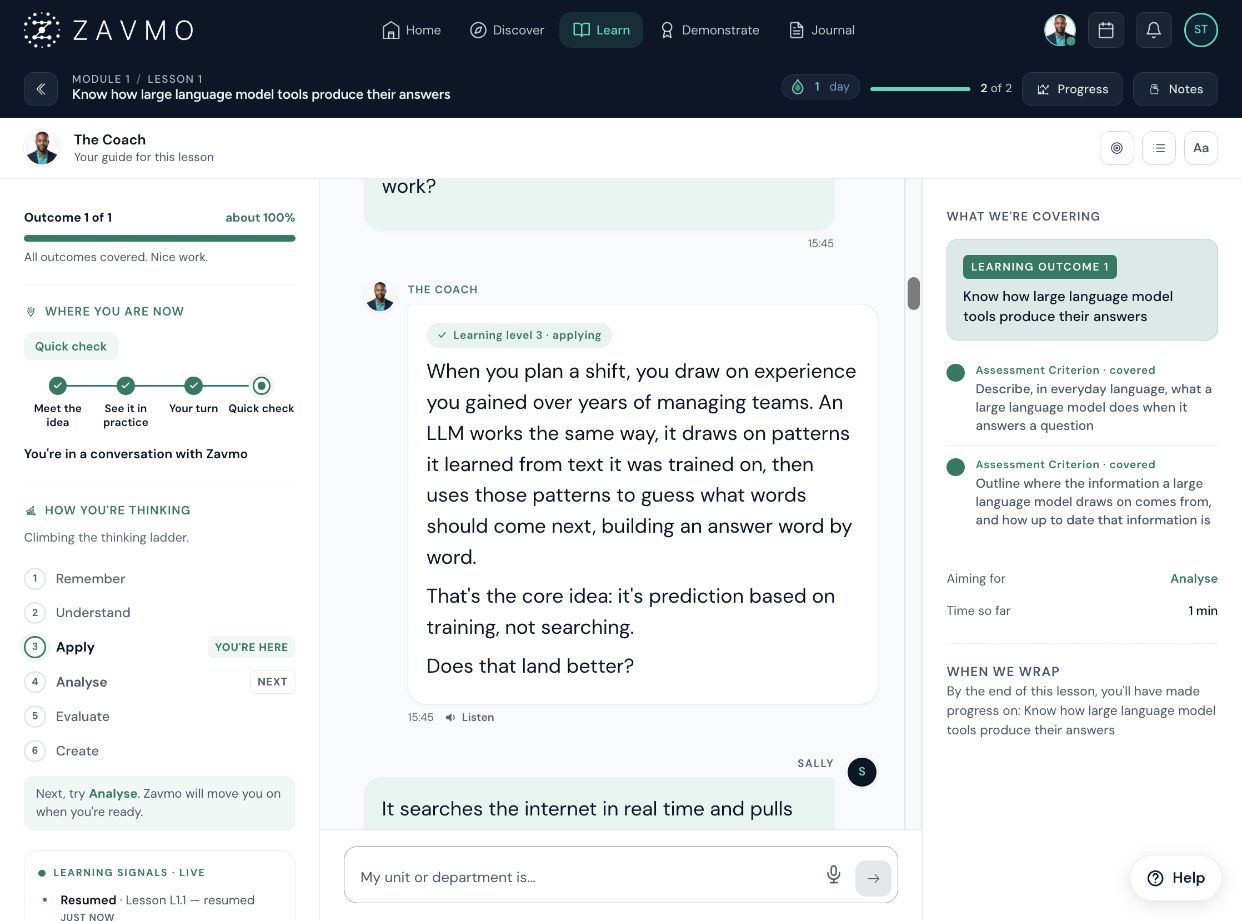
Here is what that can sound like.
Learner: taps Slower please
Zavmo: That bit got heavy. Let’s take one piece. When AI writes your report, what is the first thing you would check?
An illustrative example, not a real learner.
Learner: comes back the next morning
Zavmo: Last time we got as far as checking the numbers in a draft. Want to pick up there, or go over it again first?
An illustrative example, not a real learner.
Notice what stayed the same. You still check the draft against other sources, because that is the skill. What changed is how you got there: one piece at a time, out loud, over two mornings.
There is more on how this works in AI for neurodivergent learners, and on how the tutor adapts.
Where it stops
Zavmo is not a treatment. It does not diagnose anything, and it does not give you a teacher for a label. It watches whether the explanation in front of you is working, and changes it when it is not.
It does not replace a workplace needs assessment, or the adjustments your employer should make. It sits alongside them.
The tutor adapting is not the same as an adjustment to how you are assessed, such as extra time. If you need one of those, it is still yours to ask for.
What it does do still amazes me. Somebody who finds a page of text hard work can now learn at their own pace, out loud, ten minutes at a time. I would have loved that at school.
See how Zavmo works with dyslexia and ADHD, then start your free first Future Fluency module. If you want a place to begin, learn AI skills on one real task.