Juliette's Learning Tribe
AI tutor vs e-learning: what changes for your staff
E-learning shows everyone the same screens and counts who finished. An AI tutor checks you understood and changes course. When to use each.
I have built a lot of e-learning. Some of it was good. Some of it was rubbish.
Most of it was made the same way. Somebody wrote the content and somebody else turned it into screens. Everybody clicked through the same screens in the same order. At the end there was a quiz, and the report said who finished.
We measured whether people finished. Not whether anything changed.
E-learning is one to many. You build it once, and the audience is everybody. Different brains, different jobs, different experience, different lives. So a one-size-fits-all course rarely feels like it is about you. And if it doesn’t land emotionally, the knowledge never turns into behaviour. That is the point of Zavmo. Learners move up Bloom’s taxonomy using their own work and their own context. So new knowledge turns into what they actually do in their own job.
An AI tutor works differently. It talks with you, checks you understood and changes what it does next. That changes what it is like to learn, and what you are buying.
The same screens for everybody
E-learning is built for the middle of the room.
If you already know half of it, you click through the half you know. If you’re lost on screen four, screen five arrives anyway. There is nobody to say “hang on, I don’t get this” to.
An AI tutor starts with you. What do you do now? What do you already know? Then it teaches the gap and skips what you have.
Clicking Next is not understanding
In e-learning, the main thing you do is press Next.
You might drag a box or pick an answer, but mostly you are reading. Reading feels like learning when it often isn’t. A 2006 study by Roediger and Karpicke tested this. Some people practised recalling what they’d read. Others read it again. A week later, the ones who practised recalling remembered much more.
A tutor makes you recall. It asks you to explain things in your own words, then asks a harder question. You do the thinking, which is why it sticks.
When it hasn’t clicked
This is the biggest difference.
In e-learning, if the explanation doesn’t work for you, that’s it. You get the same words again, or you guess the quiz.
A good AI tutor notices and tries another way. A worked example, a story from your kind of work, or smaller steps.
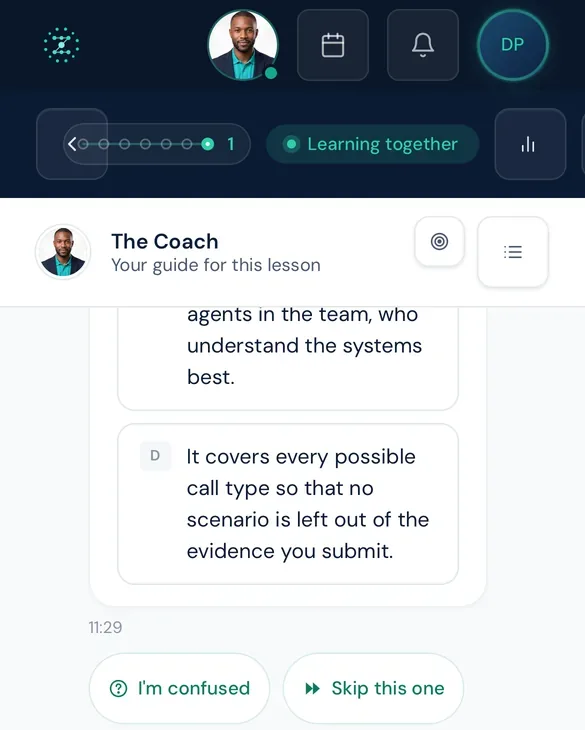
In Zavmo you can also just say so. Buttons for “I’m confused” and “Skip this one” sit right under the question. When you use them, the teaching changes.
For twenty years that was the bit I could not build. The words on screen four were the words on screen four. Now a tutor writes new ones, for you, while you’re still sitting there. I think that is extraordinary.
Reports that say who finished
E-learning reports tell you completion. Who started, who finished, who passed the quiz.
That is useful if you need proof that everyone saw the fire safety module. It tells you almost nothing about whether anybody can do anything new.
A tutor can tell you more. What each person practised, what they explained well and what they still need to work on. That is a much better conversation to have with your team than a completion percentage.
When e-learning is still the right choice
E-learning still has a place, and for some jobs it is the right tool.
- Short, fixed information. A policy everyone must read, or a process with one right way to do it.
- Proof of exposure. When a regulator wants to know everyone saw it.
- Reference. Something people come back to and search.
If the job is “make sure everyone has seen this”, e-learning is cheap and it works.
If the job is “help people get better at something”, it usually doesn’t. That is where a tutor earns its place.
The weakness of AI tutors
An AI tutor can be wrong. Large language models make mistakes, and a confident wrong answer is worse than no answer.
So it has to be built carefully. It should teach from real material and check what you understood, rather than just chat. Look at the 2025 Harvard study by Kestin and colleagues. The tutor that beat the classroom worked from answers the teachers had written. That’s the right instinct.
It also asks more of the learner. You have to type or talk, and some people find that harder at first. It is a lot more interesting than pressing Next.
Try both and see
If you have an e-learning course sitting in your system, try this. Pick someone who completed it last month. Ask them to explain the main idea to you, out loud, in two minutes.
Then give them an AI tutor on the same topic for ten minutes, and ask again.
You’ll know which one worked.
Zavmo’s first module, Future Fluency: AI skills for work, is free to try. If you’re thinking about a team, this is how it works for organisations.