Juliette's Learning Tribe
Rolling out an AI tutor to your team, one skill at a time
Start with one skill and a small group. Tell people practice is private. Then judge it on what they can do, not on who finished.
Rolling out an AI tutor is not like rolling out a course.
With a course, you assign it, send a reminder and check the completion report. Most people click through to make the reminders stop.
A tutor only works if people talk to it. They have to say “I don’t get this”, try things and get some of them wrong. Nobody does that with something they don’t trust. So most of the rollout is about trust.
Pick one skill
Start small. One skill your team needs this quarter.
Make it something they’ll use straight away. Using AI tools safely on real work is a good first one. Everybody needs it, and it is new to everybody, so nobody starts behind. Writing clearer reports works too. So does giving feedback.
Don’t start with the thing everyone has done ten times in e-learning. They’ll treat it the same way.
Start with a small group
Five to ten people is plenty. Mix them up. Somebody keen, somebody sceptical, and somebody who’s been doing the job for twenty years.
The sceptic is the most useful person in the group. If it works for them, it will probably work for the rest. If it doesn’t, they’ll tell you exactly why.
The rollout I can talk about most is with UM6P, the university in Morocco. For the first time, they were using Zavmo to teach entrepreneurship and innovation. It was part of a set curriculum, with clear outcomes and assessment. But inside that, each student could think through how their own product would actually launch. The curriculum plus one-to-one tutoring took them much deeper. What would work, what wouldn’t, and the commercial reality of making a product succeed.
Tell people three things first
Before anyone logs in, say these out loud. In a team meeting or one to one. Not buried in an email.
1. Practice is private. Getting things wrong is how it works. Nobody is marking them for their review. If people think every wrong answer is being watched, they’ll only try the easy questions.
2. What it remembers. A good tutor remembers what you’re working on and what you find hard. That’s how it adapts. Tell people what it keeps and why. In Zavmo, each lesson is saved to a learning record in the learner’s name, so the next lesson picks up where they stopped.
3. How long it takes. Ten minutes is a proper session. Nobody needs an afternoon blocked out. Say when you’d like them to do it, and make it part of the working week rather than homework.
Give it two weeks
Ask each person to do a few short sessions over two weeks. Little and often beats one long sit.
Check in once, halfway through. Don’t ask “have you done it?” Ask “what did it ask you that was hard?” The answer tells you whether they’re actually learning.
Judge it on what people can do
At the end, don’t look at completion first.
Ask each person to show you something. They could use the skill on a piece of their own work. Or they could explain the idea back to you in two minutes. Best of all is watching them do the task they couldn’t do two weeks ago.
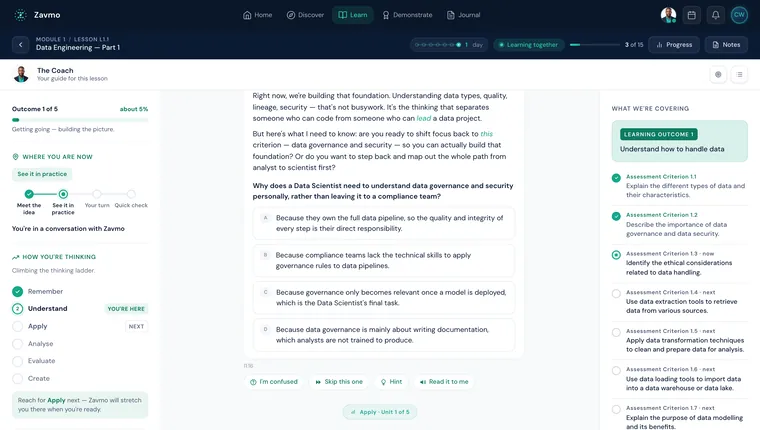
The tutor’s record helps here. It shows what each person worked on and which outcomes they covered. It is a good place to start the conversation. It is not the conversation.
Stop for a second on what just happened, too. Every person in that group had a tutor of their own for two weeks, one that knew their job. For most of my career, that was out of reach for almost everybody at work. Now it is the easy part.
Then decide
If it worked, add the next skill or the next group. If it didn’t, find out why before you go wider. Usually it’s one of three things. People didn’t have time, they didn’t trust it, or the skill wasn’t one they needed yet.
All three are fixable. None of them is fixed by sending another reminder.
Where to start
If your team is new to AI at work, start with the people side. I wrote about that here: how to introduce AI to your team when some of them do not want it.
To see the tutor first, Zavmo for organisations shows how it works for a team. Or book a 15-minute team demo and we’ll show you.