Juliette's Learning Tribe
AI literacy training for employees: what UK organisations need to do
What EU AI Act Article 4 asks of UK organisations as of November 2026, why the UK has no equivalent law, and what useful AI literacy training looks like.
If your organisation uses AI and works in the EU, the EU AI Act applies. It asks you to help your people understand the AI they use. That duty is in Article 4, and it has applied since February 2025. The UK has no law like it. But the reason to train your staff is the same in Leeds as it is in Lyon. People are already using these tools, and most of them were never shown how they work.
This is what it means in practice, as of November 2026. It is not legal advice.
What Article 4 says now
The AI Act first asked providers and deployers of AI to ensure “a sufficient level of AI literacy” in their staff. A deployer is anyone using an AI system at work. So if your team uses ChatGPT or Copilot, that is you.
In July 2026 the EU changed it. The Digital Omnibus on AI, Regulation (EU) 2026/1744, rewrote Article 4. The duty is now to take measures that support AI literacy. No set level is required of any one person.
It did not go away. The European Commission’s AI literacy questions and answers are clear on a few points:
- National market surveillance authorities supervise it, from 2 August 2026.
- It covers your staff, and also contractors and others using AI on your behalf.
- There is no need for a certificate. An internal record of the training you ran is enough.
- Staff who use a tool like ChatGPT to write or translate should be told about its risks, such as hallucination.
- Relying on the supplier’s instructions for use is not enough on its own.
So the law got softer. It still asks you to do something.
Does it apply to a UK organisation?
It can. The Commission says the AI Act applies to organisations inside and outside the EU. That includes AI placed on the EU market, AI used in the EU, and AI whose output is used in the EU.
In plain terms, look harder if any of these is true:
- You have staff or an office in an EU country.
- You sell a product or service with AI in it to EU customers.
- Your people use AI to produce work that goes to EU clients.
If none is true, Article 4 probably does not touch you. If one is, read the Commission’s Q&A with whoever advises you on law.
And if you only work in the UK
There is no UK statute on AI literacy. There is no UK AI Act. As of November 2026 the government’s approach is still the one in its response on AI regulation. Existing regulators apply a set of principles in their own sectors. The government says it will legislate when it is confident that is right.
That does not mean no rules. Data protection law still applies to anything personal your staff type into a tool. I wrote about that in is it safe to use ChatGPT at work?
And the government is pushing hard on skills. In January 2026 it opened free AI courses to every adult, aiming to reach 10 million workers by 2030. Its own research, published the same day, found only 21% of UK workers feel confident using AI at work.
That number is the real reason to act. Not a regulator.
The bit that worries me
I have built a lot of e-learning in my career. Some of it was a rubbish bit of work. I know exactly how this goes.
A rule arrives. Somebody buys a twenty minute module. Everyone clicks through it. The report says everyone finished. Nothing changes in how anyone works.
That is training built for the middle of the room and measured on who finished. It would tick Article 4. It would not stop anyone pasting a client contract into a free app on Monday.
What useful AI literacy training looks like
The Commission’s own minimum is sensible. Make sure people have a general understanding of AI. Think about whether you build AI or use it. Think about the risks of the tools you actually use.
Here is how I would turn that into training people remember.
1. List the tools people really use. Ask, without blame. Include the ones on their phones. You cannot train for tools you do not know about.
2. Start with how the answers are made. These tools do not look things up the way a search engine does. They mostly predict the next words, based on what they were trained on. Once that clicks, people check things without being told to.
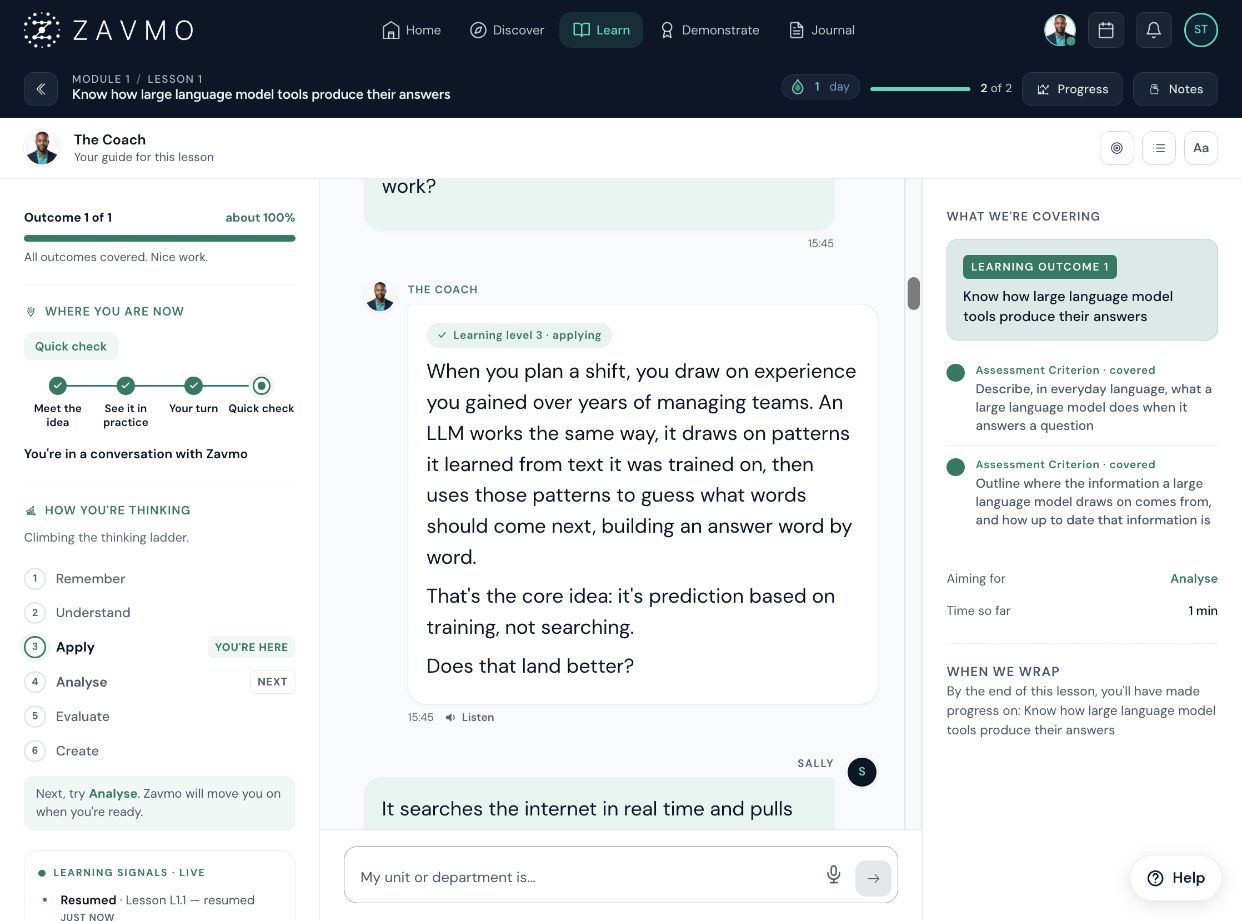
3. Teach it on their own job. A recruiter, a finance analyst and a customer service lead meet different risks. Use their real tasks, with made-up details.
4. Cover the risks they will actually meet. Wrong answers that sound sure of themselves. Personal data going where it should not. Decisions about people that a tool should never make.
5. Check they can do it, not that they finished. Ask each person to show you one task done well with AI, and how they checked it.
6. Keep a simple record. Who learned what, and when. The Commission says that is enough, and it is useful anyway.
Why I am excited about this
I am dyslexic. AI is the thing that finally got what is in my head onto the page. So when I say everyone at work should understand these tools, I mean it as an opportunity, not a compliance line.
For most of my working life, a tutor who knew your job was out of reach for almost everybody. Now it is possible for a whole team at once. I think we are living at an amazing time for learning.
Where we come in
Future Fluency is how we teach AI skills for work at Zavmo. It has three parts: working with AI in your role, managing AI in your role, and managing the change in your role.
Every lesson uses the learner’s own role and sector. The tutor checks what they understand, explains it another way when it has not clicked, and moves them on when they are ready. Each learner has a record of what they covered.
The first module is free, with a free account and no card.
If you are training a team, see how Zavmo works for organisations. Or start a 14-day team pilot for up to five people, no card needed. Pick five people who use AI every day and see what they learn in two weeks.