Juliette's Learning Tribe
Dyscalculia at work: learning with numbers that make sense
Dyscalculia can make budgets, deadlines and reports feel risky. What an AI tutor can and can't do: one step at a time, another way in, no clock, no score.
Dyscalculia at work can make anything with numbers harder and more stressful than it looks to other people. A budget, a deadline, a percentage in a report. An AI tutor can’t take the numbers out of your job. What it can do is take them one step at a time. It can explain them another way when the first way doesn’t work. And it never puts you on the clock.
Zavmo does that for everybody. It doesn’t need to know you have dyscalculia.
What dyscalculia is
The British Dyslexia Association describes dyscalculia as “a difficulty particularly in understanding and working with numbers”. Acas calls it a specific and persistent difficulty in understanding numbers. The BDA says the impact can vary from person to person and across a lifetime.
The BDA is also clear about something I recognise from dyslexia. On how dyscalculia affects adults, it says: “Most individuals are very creative in finding ways to manage.” That creativity is real. People build their own systems, and they work.
What can make learning hard
The BDA lists everyday things that can be hard for adults. Telling the time and planning schedules. Working out whether a price is reasonable. Keeping within a budget. Remembering PINs and passcodes. And it says plainly that “almost all jobs need some form of maths”.
Then there’s the fear. The BDA describes maths anxiety as a real condition, where faced with maths, people go into fight, flight or freeze. One of the experiences it names as a cause is being made to answer maths questions at speed. It also describes a cycle: afraid to have a go, so you don’t learn the skill, so the next thing is harder.
Maths anxiety and dyscalculia aren’t the same thing, but the BDA covers them side by side. A lot of workplace training does exactly what feeds that cycle. A timed quiz. A score at the end. A number you’re expected to just know.
How Zavmo supports learning with dyscalculia
First, what Zavmo isn’t. It isn’t a maths tutor. It has no calculator, and it is not a maths course. It teaches AI skills and skills for work. Numbers turn up in those, in budgets, reports and data, and that’s where this helps.
There’s also no dyscalculia mode, and no teacher for dyscalculia. Instead, a thirteenth agent, Agent 13, watches every lesson as it runs. It watches how you’re engaging and how much you’re being asked to hold at once. When an explanation isn’t landing, it brings in a different one of the twelve teaching characters, and tells you why in one line.
On for everyone:
- Worked examples, one step at a time. Every character is set up to answer in a few sentences, one idea at a time. A calculation can be shown as a run of small steps rather than one leap.
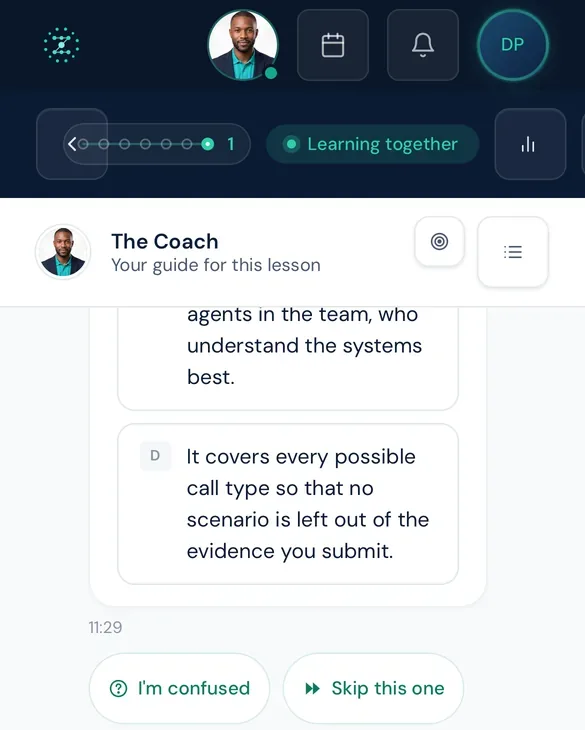
- Explain it another way. Tap I’m confused or Show me an example and the explanation changes. A different example, often from your own kind of work.
- No clock. There is no timer. You answer when you’re ready, and you choose how long a session runs, from 5 to 10 minutes up to an hour. If you’d rather not be hurried at all, choose more time to answer in your support preferences.
- Practice is never scored. Get the number wrong and go again. It doesn’t count against you.
- Hint. A nudge towards the next step, when you want one.
- Listen. Tap it to hear any reply read aloud, figures included.
- Skip this one. If a question isn’t the one you need right now, move on.
- Save and finish later. Stop when you need to. Your place is kept in a learning record in your name.
Two examples
An illustrative example, not a real learner.
Learner: The AI summary says our spend went from £12,000 to £10,500, a 12.5% drop. I’ve no idea if that’s right.
Zavmo: Let’s check it one step at a time. Step one: the difference. £12,000 take away £10,500 is £1,500. Does that part make sense?
Learner: Yes.
Zavmo: Step two. How many lots of £1,500 make £12,000? It’s eight. So the drop is one eighth of what you started with. One eighth is 12.5%. The AI was right this time.
What changed: The learner tapped I’m confused at the formula. The tutor dropped it and used a worked example in small steps, with the learner’s own figures.
An illustrative example, not a real learner.
Learner: This report says sales went up 40%. I’m panicking a bit. I can’t do the sum.
Zavmo: There’s no clock on this, and nothing is scored. Let’s go back to basics and not calculate at all. Sales were £50,000 and now they’re £70,000. Is the rise more than half of £50,000, or less?
Learner: Less. Half would be £25,000.
Zavmo: Exactly. So the rise is less than 50%. 40% is believable. That’s a check you can do without any sums.
What changed: The learner said they were panicking, so the tutor went back to basics. It swapped calculating for estimating, the “is this reasonable?” question the BDA names as a hard one.
In both, the check is the one everyone learns: is the AI’s figure right? Only the way in changed, from a formula to small steps or a rough estimate.
At work
If you have dyscalculia, you have rights at work. This is what that means in practice, not legal advice.
- Acas explains that being neurodivergent will often count as a disability under the Equality Act 2010. That gives you the right to reasonable adjustments.
- Acas lists example adjustments such as extra time to read and complete tasks, step-by-step instructions and having information talked through.
- As of November 2026, Access to Work can help pay for support such as assistive software if you have a condition or disability.
Where it stops
Zavmo is not a diagnosis, and it is not a treatment. It won’t assess you for dyscalculia. The BDA has a page on assessment and support if you want to know more.
It also isn’t a numeracy course. If you need to build maths skills from the ground up, a specialist will do that far better.
The research on AI tutors for adults with dyscalculia at work is thin. Most tutoring studies come from schools and universities. We haven’t published a study of our own.
What I love is the patience. A tutor will show you the same sum three different ways, and never sigh. For most of my career, that kind of patience was the most expensive thing in learning. Now anyone can have it.
Try it
Your first module, Future Fluency: AI skills for work, is free. No card needed. Working with AI in your role means checking what it gives back, and that includes its numbers.
You can read how Zavmo works for different minds, or my wider piece on AI for neurodivergent learners. If attention is the harder part for you, I’ve written about ADHD and learning at work.