
Juliette's Learning Tribe
How adults learn best at work, and how to learn faster
Adults learn best at work on real tasks: recall it, come back to it, talk it through. What the research says, with one thing to try in each part.
Adults learn best at work when they learn on a real task from their own job. They pull it back out of their own head instead of rereading it. They come back to it over a few days, and talk it through with someone who asks questions. Short sessions with full attention beat long ones with half of it.
That is most of it. The rest of this guide is why each part works, what the research says, and one thing to try this week.
I have built learning for adults for decades. Platforms, e-learning, the lot. Most of what I built was made for the middle of the room and measured on who finished. And most of us were never taught how to learn. We were taught things, then left to work out the how on our own.
So people reread. They highlight. They sit through the course, pass the quiz, and wonder by Friday why so little stuck. That was never the people. It was the method.
Stop rereading and test yourself
Rereading feels like learning. Mostly it is not.
When you read your notes again, the words look familiar. Your brain mistakes familiar for known. Then a client asks you the question with no page in front of you, and it has gone.
In 2006 Henry Roediger and Jeffrey Karpicke tested this with students. Some read a passage again. Others practised recalling it with the page away. Five minutes later, the rereaders did better. Two days later, and a week later, the ones who had practised recalling remembered far more.
The part I love is this. Rereading made the students more confident. They felt surer and remembered less.
A big review of ten study habits by John Dunlosky and colleagues landed in the same place. Practice testing was one of only two habits rated highly useful. Rereading and highlighting, the two most people rely on, were rated low. There is a plain-English version of the review if you want the detail.
The catch is that testing yourself feels worse. You get things wrong, and it is uncomfortable. That is the method working. It is also why most people quietly go back to the highlighter.
Try this: after a meeting or a course, close everything. Write down what you remember, from memory. Then check. The gaps are your next ten minutes.
Come back to it over a few days
The other habit rated highly useful was spreading practice out. The same hour does more good split across a week than crammed into one sitting.
Forgetting is normal, and it is fast. In the 1880s Hermann Ebbinghaus measured how quickly he forgot lists he had learned. In 2015 Jaap Murre and Joeri Dros repeated his experiment. One person spent seventy hours learning lists for it, and the curve came out much the same. Memory drops away quickly at first, then levels off. Once you expect that, you can plan for it.
Sleep is part of the plan. A review by Susanne Diekelmann and Jan Born describes sleep as the state that best helps the brain keep new learning. A short session and a proper night’s sleep beats a late one.
At fifty four I joined a knitting group to make a blanket. A blanket is only squares. You learn one square properly. Then you make it again, on a different evening, and again after that. The doing it again is the learning. Work is no different.
Try this: pick one idea you need for work. Spend five minutes recalling it today, tomorrow, in three days and next week. Put the four slots in your calendar now, while you are reading this.
Give it one clean block of attention
Your attention is where learning starts. Switching between tasks costs more than it seems.
Sophie Leroy studied people moving between work tasks. When people left a task unfinished, part of their attention stayed stuck on it, and they did worse on the next one. She called it attention residue. So the thirty seconds on a message is never only thirty seconds.
A few things make focus easier without relying on willpower, which loses to a buzzing phone every time.
- Put the phone in another room and turn notifications off. Make the distraction take effort to reach.
- Decide the exact next step before you start. “Learn the new reporting tool” drifts. “Rebuild last week’s report in it” holds you.
- Close off what you were doing first. Finish it, or write one line on where you stopped.
- Give your sharpest hour to the hardest thing. For a lot of people that is the morning.
- Keep it short, and rest on purpose. Stand up, look out of a window, walk. Scrolling is more input, so it does not count.
Focus grows with use. The first few clean blocks feel hard because you are out of practice. Start with a length you can win, then stretch it.
In Zavmo you choose how long a session runs, from five minutes up to an hour. Save and finish later keeps your place when a meeting runs over.
Try this: tomorrow, give one learning task twenty five minutes with the phone out of the room. Notice what still pulls you away. That is your list.
Talk it through
Think about the last thing you learned that stayed with you. You probably did not get it from rereading a page. You did it, argued about it, or had to explain it to someone.
A conversation makes you do what works. Every question is a small recall test. Putting an idea into your own words shows you straight away whether you understand it. The Dunlosky review rated explaining things to yourself as promising, with less evidence behind it so far than testing.
A good conversation also meets you where you are. It slows down where you are stuck and skips what you already know. A famous 1984 paper compared students taught one to one with students taught in an ordinary class. The average tutored student finished above 98 per cent of that class.
The problem was always cost. Nobody could give every learner their own tutor. So we settled for one trainer, thirty people and a slide deck, and we called the forgetting that followed normal.
It was never normal. It was just the best we could afford.
What gets people going is hands-on. Playing with a new skill in a role play or a worked example. That makes you curious about how it would land. A one-to-one conversation with a tutor is a great way to do it. But only if you trust what sits behind it. Good examples, and a clear structure for what you’re meant to learn and how you’ll be assessed. A general AI chatbot doesn’t have that, so it works far less well.
This is the bit that makes me buzz. For twenty years I could not build that conversation into a course. Now a tutor can have it with every learner at once.
In 2025 Greg Kestin and colleagues at Harvard ran a trial in a physics course. Students who used a carefully designed AI tutor learned significantly more, in less time, than students in an active class in the room. They also said they felt more engaged.
The weakness is real. An AI tutor can be wrong, and it sounds just as sure when it is. The Harvard team knew that. They did not let the AI work out the answers on its own. They gave it worked solutions and prompts written by teachers who knew the subject. That is the standard I hold any tutor to, ours included.
In a Zavmo lesson you talk or type, and the tutor asks you back. When an explanation is not landing it tries another way, sometimes with a different teacher. There are twelve teaching characters, and you can change yours whenever you like.
Try this: after you learn something new, explain it to a colleague in two minutes. Or ask an AI tool to quiz you on it, one question at a time. Tell it to hold back the answer until you have tried.
How your brain files new ideas
New ideas come in through a very small space. A 2017 paper from the New South Wales education department puts it at about four chunks at once for an average person. That figure comes from Nelson Cowan’s 2001 review. Overload it and nothing goes in. That is why a forty-slide induction bounces off people.
What gets round the limit is what you already know. Read the letters B, T, L, A, E once and look away. Annoying to hold. Now read T, A, B, L, E. Same five letters, but the second time they are one word, so they are one thing to hold. Your long-term memory did the work.
That is the real reason learning on your own work is faster. You already have years of files on your job: the clients, the systems, the way your team does things. A new idea tied to one of those has somewhere to live. A new idea in somebody else’s example has to start from nothing.
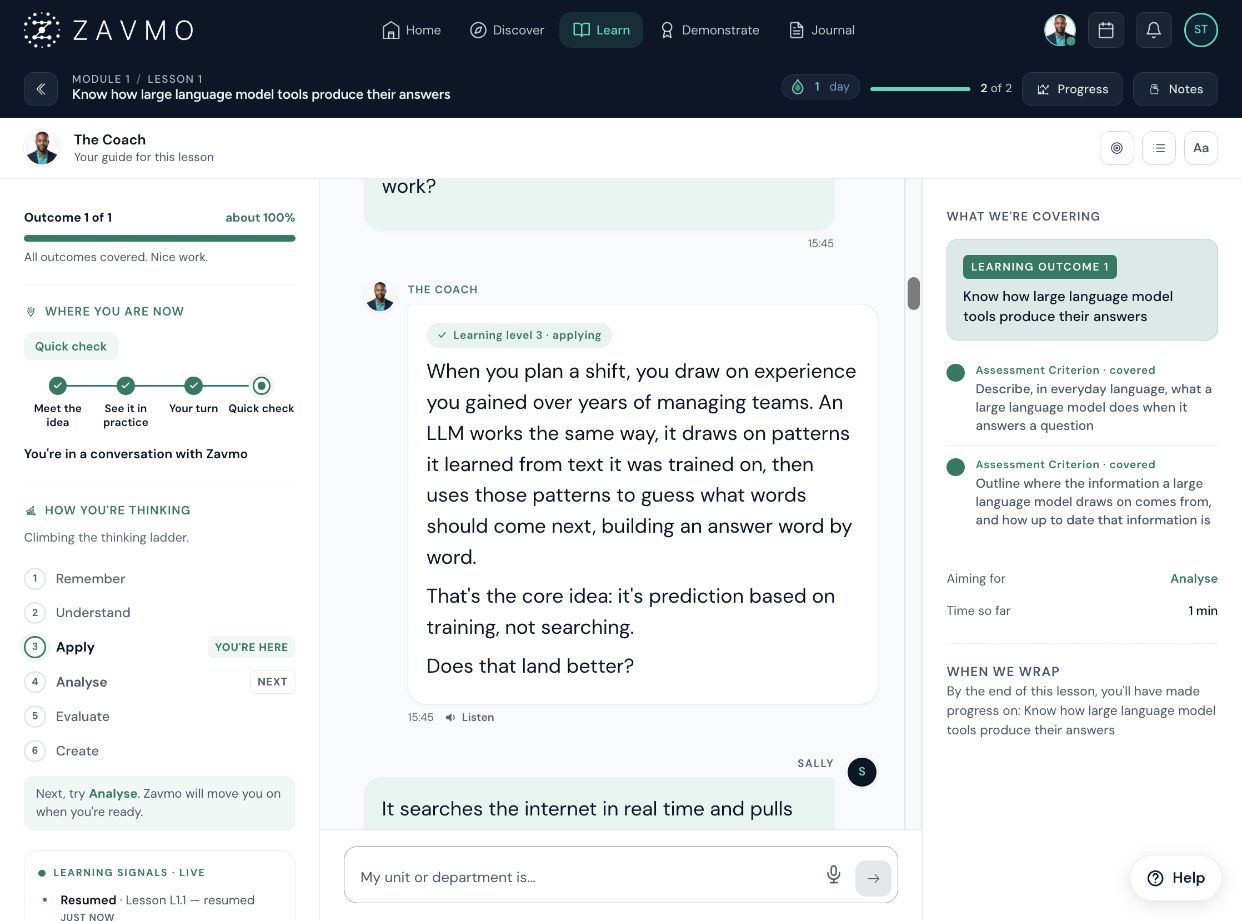
So keep new things small. One piece at a time, each one hung on something you already know. Once you have the pieces, mix your practice. Doing a few different kinds of problem in one session feels slower, and it teaches you to choose the right approach. The Dunlosky review rated that as promising too.
Try this: for each new idea, finish the sentence “this is like … in my job”. If you cannot finish it, that is the part to ask about.
Nobody learns like the person next to them
People really do differ. How much they can hold at once, how fast they take things in, when in the day they are sharp. The NSW paper notes the evidence for differences in working memory between people.
What does not hold up is learning styles. Being told you are a visual learner, then taught only in pictures, does not help you learn more. We set out the research on both on our science page.
I am dyslexic. For most of my life, getting what was in my head onto a page took forever or did not happen. I built Zavmo as the platform I wish I had had growing up.
There is a word for teaching that starts from the real person rather than the average one. Neurogogy means being taught how you learn, not only what you learn. The idea is that fitting the teaching to you was always the system’s job, never yours. It is what Zavmo is built on.
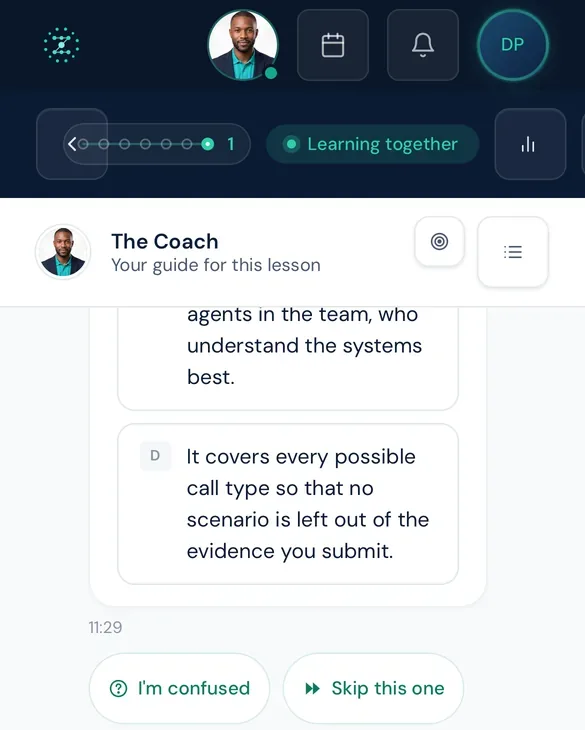
In practice it looks like small things. One-tap buttons sit under each tutor message, such as I’m confused, Slower please and Show me an example. “Skip this one” appears on a question when you already know it. You can talk instead of typing, and Listen reads any reply aloud. Practice is not scored.
Try this: notice when you are sharpest, and whether you like an example first or the big picture first. Then ask for it, from a colleague, a trainer or a tutor.
Start with the thing that is changing your job
If you are not sure what to learn first, start with AI at work. It is where all of this matters most. The tools keep changing, and a course from last year is already behind.
There is a short guide on learning AI skills one real task at a time on this blog. Future Fluency, our AI skills for work, is built on everything above. You learn on your own role, in short sessions, with a tutor that asks you back and changes course.
The first module is free, with a free account and no card.
Sources
- Roediger, H. L. and Karpicke, J. D. (2006), Test-Enhanced Learning: Taking Memory Tests Improves Long-Term Retention, Psychological Science, 17(3): doi.org/10.1111/j.1467-9280.2006.01693.x
- Dunlosky, J., Rawson, K. A., Marsh, E. J., Nathan, M. J. and Willingham, D. T. (2013), Improving Students’ Learning With Effective Learning Techniques, Psychological Science in the Public Interest, 14(1): doi.org/10.1177/1529100612453266. Plain-English version, American Educator, Fall 2013: aft.org
- Murre, J. M. J. and Dros, J. (2015), Replication and Analysis of Ebbinghaus’ Forgetting Curve, PLOS ONE: doi.org/10.1371/journal.pone.0120644
- Diekelmann, S. and Born, J. (2010), The memory function of sleep, Nature Reviews: doi.org/10.1038/nrn2762
- Leroy, S. (2009), Why is it so hard to do my work? The challenge of attention residue when switching between work tasks: doi.org/10.1016/j.obhdp.2009.04.002
- Centre for Education Statistics and Evaluation, NSW Department of Education (2017), Cognitive load theory: Research that teachers really need to understand: education.nsw.gov.au
- Cowan, N. (2001), The magical number 4 in short-term memory: a reconsideration of mental storage capacity: doi.org/10.1017/S0140525X01003922
- Bloom, B. S. (1984), The 2 Sigma Problem: The Search for Methods of Group Instruction as Effective as One-to-One Tutoring, Educational Researcher, 13(6): doi.org/10.3102/0013189X013006004
- Kestin, G., Miller, K., Klales, A., Milbourne, T. and Ponti, G. (2025), AI tutoring outperforms in-class active learning, Scientific Reports, 15: doi.org/10.1038/s41598-025-97652-6
