
Juliette's Learning Tribe
Autism and learning at work: how an adaptive tutor can help
Autism can make vague instructions, sudden changes and busy training rooms hard work. How a predictable, plain-spoken AI tutor helps you learn at work.
Autism can affect learning at work in a few ways autistic people often describe. Instructions that leave too much unsaid. Changes nobody warned you about. Training rooms that are loud, busy and social. An adaptive tutor helps by being predictable and saying exactly what it wants from you. It also lets you learn on your own, at a time and place you choose.
That’s how Zavmo teaches everybody. It never needs to know you’re autistic.
What autism is
The National Autistic Society describes autism as a lifelong neurodivergence and disability that influences how people experience and interact with the world. Autistic people differ from each other a great deal. Many see the characteristics of autism as positive and helpful.
Some of the strengths are easy to see at work. The Society says autistic people with focused interests may become experts in them, and that an interest can be a route into a job. The government’s Buckland Review of Autism Employment, published in February 2024, puts it plainly: autistic people “have brilliant skills and ways of thinking.”
What can make learning hard
The Society describes a preference for order, predictability and routine. Routines can help people plan, stay calm and cope with stress. So a course that changes shape without warning is hard going.
It also describes sensory overload: taking in so much sensory information that you can’t process any more. A full training room, with group work and someone talking over the slides, is a lot to take in.
And plenty of workplace training is built on role play, breakout groups and “turn to the person next to you”. It assumes everyone learns best out loud, in a crowd.
The Buckland Review heard that training on autism run by employers is often poor. I’d go further. A lot of ordinary training is quietly hard for autistic people, whatever it’s about.
How Zavmo supports autistic learners
We don’t have an autism mode, or a teacher for autistic people. Matching a teaching style to a diagnosis is the old learning styles idea with a label attached. A 2008 review by Pashler and colleagues found no adequate evidence that teaching to a person’s “style” helps.
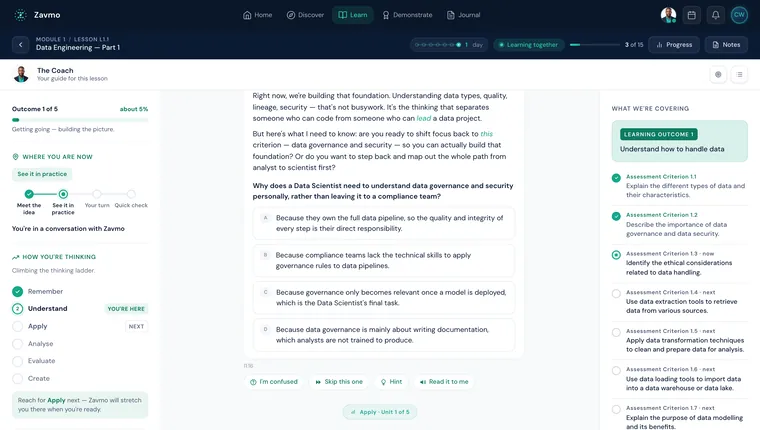
What we do is watch the lesson. A thirteenth agent, Agent 13, follows every lesson while it runs. It watches how you’re engaging and how much you’re being asked to hold at once. When an explanation isn’t landing, it brings in a different teacher and tells you why. Here is what that looks like, for everyone:
- The same four steps, every time. Each part of a lesson runs the same way. Meet the idea, see it in practice, your turn, quick check. On a laptop, you can see which step you’re on.
- You can see what the lesson covers. On a laptop, it’s listed beside the conversation, with what you’ll have made progress on by the end.
- Short replies, one idea at a time. Every character is set up to answer in a few sentences. One question at a time, in writing you can reread.
- Change is explained. When Agent 13 changes the teacher, it tells you why, in one line. Nothing changes behind your back.
- You can change teacher yourself. Prefer the one you had? Pick them in Change tutor, and it stops switching for that lesson.
- Learning one to one. No breakout groups, no role play in front of colleagues. From 5 to 10 minutes up to an hour, at your desk, at home or on your phone.
- Talk or listen. Type, speak your answer, or tap Listen to hear any reply.
- Ask for it plainer. One-tap buttons sit under each tutor message, such as I’m confused, Slower please and Show me an example. Make it easier is always in the tutor menu. Practice is never scored.
- You can see what Zavmo remembers. It’s in Settings. To change or delete it, email hello@zavmo.ai.
Two examples
An illustrative example, not a real learner.
Learner: When you say “review the AI’s meeting notes”, what exactly do you want me to check?
Zavmo: Good question. Three things. One: are the names right? Two: is every action given to a person? Three: does any line say something nobody said in the meeting? Tell me what you find for the first one.
What changed: The first instruction was vague. The tutor turned it into three numbered checks, said what done looks like, and asked for one at a time.
An illustrative example, not a real learner.
In the lesson: The Builder steps in, taking over from the Analyst. The definition wasn’t landing, so here’s a worked example.
Zavmo: Let’s use a team budget. The question at the end stays the same.
Learner: opens Change tutor and picks the Analyst again
Zavmo: Back to the definition, then. I’ll break it into two shorter parts.
What changed: Agent 13 saw the definition wasn’t landing. It brought in a different teacher and gave a one-line reason. The learner preferred the first teacher and picked them again, so the switching stopped for that lesson. The goal stayed fixed.
It would do the same for anyone whose lesson went that way. That’s the point.
The goal is fixed for everybody, so you always know what done looks like. Only the route to it changes, and you’re told when it does.
At work
Autistic people have rights at work. This is what they mean in practice, not legal advice.
- Acas explains that being neurodivergent will often count as a disability under the Equality Act 2010. That gives you the right to reasonable adjustments.
- The National Autistic Society lists support you can ask for, such as written step-by-step instructions and agreed notice of changes to your workload.
- Acas has examples of adjustments for sensory overload, such as a quiet space and early warning of workplace changes.
- As of November 2026, Access to Work can help pay for support if you have a condition or disability.
For employers, the Buckland Review’s last recommendation is training for autistic staff that builds on their strengths. A tutor that changes the teaching, rather than asking the learner to change, is one simple place to start.
Where it stops
Zavmo is not a diagnosis, and it is not a treatment. It can’t make your office quieter or your manager clearer. It can make the learning part calmer.
The research on AI tutors for autistic adults at work is thin. Most studies of tutoring come from schools and universities. We haven’t published a study of our own.
What excites me is the patience. A tutor will give you the third, more exact version of an instruction as happily as the first. For most of my career that cost a fortune, so almost nobody got it.
Try it
Your first module, Future Fluency: AI skills for work, is free. No card needed. Each part of every lesson runs through the same four steps, so you’ll know the shape before you start.
Read how Zavmo works for different minds, or my wider piece on AI for neurodivergent learners. If attention and momentum are the harder part for you, I’ve written about ADHD and learning at work too.
