
Cambridge OCRRQF Level 3
Cambridge OCR Level 3 Cambridge Technical Certificate in IT
Zavmo teaches it and the awarding body awards it. You practise each unit one-to-one, on your own real work.
- Units Listed
- 43
- Credits
- 30
- Qualification Reference
- 600/4228/X
The Course Content. Taught Through Your World.
How Zavmo Teaches This Course to You
Bring your role, your experience and the questions you face. Explore the course through examples that mean something to you.
Bring a Question From Your Work
A Familiar Starting Point.
A project. A budget. A conversation you need to prepare. See how familiar situations can make a new idea clearer.
The examples shape the teaching. The course requirements stay the same.
From the Product
An Explanation Connected to Your Work
In this test lesson, the learner asked for an explanation using shift planning. The tutor responded through that familiar situation.
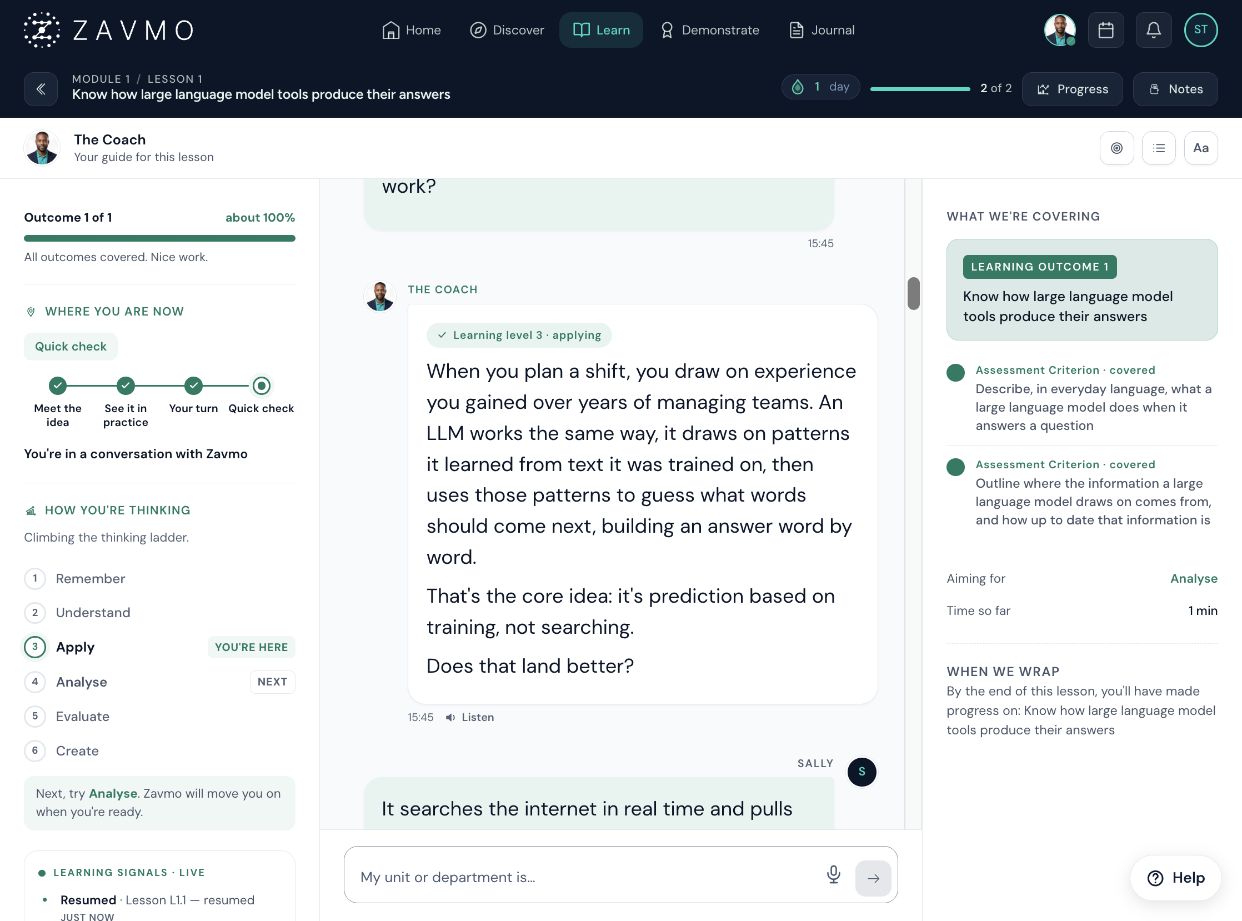
- 01 · Start With You
Your role, existing knowledge and the situation you want to understand.
- 02 · Work Through It
Ask for another explanation. Explore an example. Explain your reasoning.
- 03 · Practise the Outcome
Use what you have learnt in a relevant task, with the course outcome kept in view.
Your examples shape the teaching. They do not change the awarding body’s requirements. Use anonymised or fictional details for client situations.
How You Would Get This Certificate
- Zavmo teaches you. You learn the units one-to-one with an AI tutor, on your own work.
- You register with an approved centre. That is a college, training provider or employer Cambridge OCR has approved to offer this qualification. Zavmo is not an approved centre, so you register with them, not with us.
- The centre assesses, and Cambridge OCR awards. A qualified assessor at the centre judges your evidence, and the certificate comes from Cambridge OCR.
The Level 3 Cambridge Technical Certificate in IT offers learners the opportunity to prepare for further learning or training. Essential knowledge, transferable skills and personal development are fostered. Units cover communication, employability, information systems and network management.
These are the units Cambridge OCR registers against this qualification. It is a catalogue, not a syllabus. Which of them you take depends on the combination the qualification requires, and that is set by the awarding body rather than by us. Every unit here is regulated. Zavmo teaches towards them on your own work.
Zavmo is not an awarding body, is not an approved centre, and is not affiliated with Cambridge OCR. It does the teaching and the mapping. Cambridge OCR sets this qualification and awards it, and a qualified human assessor makes the assessment decision.
What You Will Learn in Each Unit
*Business resources Real unit · Cambridge OCR
What you'll be able to do
- Know how human resources are managed within a business context, including recruitment, training and performance management.
- Know the purpose of managing physical and technological resources effectively, including maintenance, security and sustainability.
- Access various sources of finance for business operations and growth, including loans, grants and investment.
- Interpret financial statements, including balance sheets, income statements and cash flow statements.
*The business environment Real unit · Cambridge OCR
What you'll be able to do
- Know the range of different businesses and their ownership structures, including sole traders, partnerships and limited companies.
- Understand how businesses are organised to achieve their purposes, including organisational structures and functional areas.
- Know the impact of the economic environment on businesses, including factors such as inflation, interest rates and unemployment.
- Know how political, legal and social factors impact on business operations and decision-making.
2D animation production Real unit · Cambridge OCR
What you'll be able to do
- Understand the techniques and development processes involved in creating 2D animation.
- Devise a 2D animation concept, including storyboarding and soundtrack planning.
- Produce a 2D animation with a soundtrack, using appropriate software and techniques.
- Evaluate audience responses to your own 2D animation work and identify areas for improvement.
Client side customisation of web pages Real unit · Cambridge OCR
What you'll be able to do
- Understand the fundamental principles of Cascading Style Sheets (CSS) and their role in web design.
- Understand the fundamental concepts of scripting languages used for client-side web development.
- Control the layout of web pages using CSS, including positioning, styling, and responsiveness.
- Create interactive web pages using scripting languages to enhance user experience.
Cloud computing in business Real unit · Cambridge OCR
What you'll be able to do
- Understand fundamental cloud computing concepts and terminology
- Understand different cloud computing models, including Infrastructure as a Service (IaaS), Platform as a Service (PaaS), and Software as a Service (SaaS)
- Understand the different cloud deployment models, including public, private, hybrid, and community clouds
- Understand the components of cloud computing infrastructure for organisations
- Understand how virtualisation technologies underpin cloud infrastructure
- Understand how to manage networks in a cloud computing environment
- Understand the principles of network security in the cloud
- Understand the requirements for data security and privacy in the Cloud
- Understand the importance of identity and access management in the cloud
- Understand the impact of cloud computing on IT service management (ITSM)
- Understand how cloud computing changes traditional IT roles and responsibilities
- Understand the benefits and challenges of adopting cloud computing for IT service management
Communication and employability skills for IT Real unit · Cambridge OCR
What you'll be able to do
- Understand the personal attributes valued by employers
- Understand the principles of effective communication
- Use IT to communicate effectively
- Address personal development needs
Communication technologies Real unit · Cambridge OCR
What you'll be able to do
- Understand the communication principles of computer networks, including protocols, topologies, and security considerations.
- Know the main elements of data communications systems, including hardware, software, and transmission media.
- Implement different forms of network communications, such as wired, wireless, and cloud-based solutions.
Computer animation Real unit · Cambridge OCR
What you'll be able to do
- Understand the different types of animation and their various applications in different industries.
- Know the software techniques used in creating animations, including keyframing, tweening, and rigging.
- Design and implement digital animations using appropriate software and techniques.
Computer game design Real unit · Cambridge OCR
What you'll be able to do
- Explain the fundamental principles of computer game design.
- Generate innovative ideas for a computer game concept.
- Prepare comprehensive game design documentation, including specifications and storyboards.
- Present a game concept effectively to stakeholders, incorporating feedback and revisions.
Computer game platforms and technologies Real unit · Cambridge OCR
What you'll be able to do
- Understand the different types of game platforms available, including consoles, PCs, and mobile devices.
- Understand the hardware technologies used in game platforms, such as processors, graphics cards, and memory.
- Understand the software technologies used in game platforms, such as operating systems, game engines, and APIs.
- Connect and configure different game platforms and devices to enable gameplay, including troubleshooting common issues.
Computer networks Real unit · Cambridge OCR
What you'll be able to do
- Identify and describe different types of network systems, including LANs, WANs, and VPNs.
- Explain the functions of each type of network system.
- Describe various network protocols, including TCP/IP, HTTP, and FTP.
- Explain the purpose and function of each network protocol.
- Identify and describe the key components used in networking, including routers, switches, and firewalls.
- Explain the functions of each component within a network.
- Describe the services provided by network systems, including email, file sharing, and web hosting.
- Explain the benefits of each network service.
- Implement security measures to protect networked systems from unauthorised access.
- Configure firewalls and intrusion detection systems to prevent security breaches.
Computer systems Real unit · Cambridge OCR
What you'll be able to do
- Identify and describe the different components of computer systems, including hardware and software.
- Explain the functions of each component within a computer system.
- Evaluate the performance characteristics of different computer system components.
- Recommend appropriate computer systems based on specific business requirements and constraints.
- Justify the selection of computer system components based on cost, performance, and compatibility.
- Set up computer systems according to manufacturer specifications and industry best practices.
- Configure operating systems and software applications to meet user needs.
- Perform routine maintenance tasks on computer systems, including software updates and hardware checks.
- Troubleshoot common computer system problems and implement effective solutions.
Data analysis and design Real unit · Cambridge OCR
What you'll be able to do
- Know different modelling methodologies used in data analysis and design.
- Understand the principles and techniques of logical data modelling.
- Produce logical data models based on given requirements.
- Implement logical data models using appropriate database management systems.
- Test implemented logical data models to ensure data integrity and functionality.
Database design Real unit · Cambridge OCR
What you'll be able to do
- Understand the key features and characteristics of relational databases.
- Design a relational database based on given requirements.
- Create a relational database using appropriate software.
- Populate a relational database with relevant data.
- Test a relational database to ensure functionality and data integrity.
Developing a smarter planet Real unit · Cambridge OCR
What you'll be able to do
- Understand the core concepts and characteristics of a 'smarter planet'
- Understand how the business environment is evolving in response to 'smarter planet' initiatives
- Understand how 'smarter planet' technologies could be further developed and applied in various contexts
Developing computer games Real unit · Cambridge OCR
What you'll be able to do
- Understand the significant impact of the gaming revolution on society and culture.
- Know the characteristics of different types of computer game genres and platforms.
- Design and develop engaging computer games using appropriate software and techniques.
- Test and document computer games thoroughly to ensure quality and functionality.
Developing programming solutions Real unit · Cambridge OCR
What you'll be able to do
- Understand the software development process
- Develop a programming solution
- Understand validation and verification processes
- Produce a functional programming solution
- Document a programming solution
Digital graphics Real unit · Cambridge OCR
What you'll be able to do
- Know the hardware and software components required to work effectively with digital graphic images.
- Understand the different types of graphic images (e.g., raster, vector) and graphical file formats (e.g., JPEG, PNG, SVG).
- Use editing tools to edit and manipulate images, including resizing, cropping, and colour correction.
- Create and modify graphic images to meet specific user requirements, considering factors such as resolution, file size, and visual appeal.
Digital graphics for interactive media Real unit · Cambridge OCR
What you'll be able to do
- Explain the theory underpinning digital graphics technology.
- Describe the applications of digital graphics technology in interactive media.
- Generate creative ideas for digital graphics suitable for an interactive media product.
- Create digital graphics for an interactive media product, adhering to industry best practice.
Exploring computer applications Real unit · Cambridge OCR
What you'll be able to do
- Understand key features of computer applications, including their functionality, user interface and data handling capabilities.
- Understand different uses for computer applications, considering their application in various industries and contexts.
- Develop a computer application, applying appropriate programming techniques and design principles to meet specified requirements.
- Document solutions for a computer application, providing clear and concise instructions for installation, usage and maintenance.
IT systems troubleshooting and repair Real unit · Cambridge OCR
What you'll be able to do
- Understand how organisational policies can affect IT troubleshooting and repair, including security protocols, data protection regulations, and acceptable use policies.
- Use appropriate tools to troubleshoot IT problems, including diagnostic software, hardware testers, and network analysers.
- Select and apply fault remedies to IT systems, including hardware replacement, software updates, and configuration changes.
IT technical support Real unit · Cambridge OCR
What you'll be able to do
- Understand the tools and techniques used for providing effective technical support.
- Understand how organisational policies and procedures influence the delivery of technical support.
- Gather information effectively to provide appropriate advice and guidance to users.
- Communicate advice and guidance clearly and concisely to users.
Impact of the use of IT on business systems Real unit · Cambridge OCR
What you'll be able to do
- Understand the effect of developments in information technology on organisations, including their structure, processes, and performance.
- Understand how organisations respond to information technology developments, including the adoption of new technologies and the adaptation of existing systems.
- Propose improvements to business systems using IT, justifying the proposed changes and considering their potential impact.
Information systems Real unit · Cambridge OCR
What you'll be able to do
- Understand how organisations use business information
- Understand the issues related to use of information
- Know the features and functions of information systems
- Use IT tools to produce management information
Installing and upgrading software Real unit · Cambridge OCR
What you'll be able to do
- Understand the reasons why software installations or upgrades are necessary in various contexts.
- Prepare the system and environment for a software installation or upgrade, including backing up data and checking compatibility.
- Install or upgrade software according to specified procedures and best practices.
- Understand the processes involved in completing the installation or upgrade and handing over the software to the user or client.
Interactive media authoring Real unit · Cambridge OCR
What you'll be able to do
- Understand the fundamental principles of interactive media authoring, including user interface design and navigation.
- Devise an interactive media product concept, including defining its purpose, target audience, and functionality.
- Create an interactive media product following industry best practices, using appropriate authoring tools and techniques.
Key computing concepts for IT solutions Real unit · Cambridge OCR
What you'll be able to do
- Know key concepts of computing and programming used to design IT solutions
- Apply mathematical concepts to computing
- Understand developmental techniques for IT solutions
- Understand the developmental cycle for IT solutions
Maintaining computer systems Real unit · Cambridge OCR
What you'll be able to do
- Understand the organisational issues related to the effective maintenance of computer systems.
- Plan computer system maintenance activities to minimise disruption.
- Perform routine housekeeping tasks on computer systems to ensure optimal performance.
- Monitor and improve systems performance through proactive maintenance and optimisation techniques.
Managing networks Real unit · Cambridge OCR
What you'll be able to do
- Identify and describe a range of networking management tools and technologies.
- Explain the purpose and function of different network management tools.
- Evaluate the effectiveness of various network management technologies.
- Explain the key functions of network management, including monitoring, configuration, and security.
- Describe the processes involved in network performance management.
- Analyse network traffic and identify potential bottlenecks or security threats.
- Carry out network management activities, such as configuring network devices and monitoring network performance.
- Implement security measures to protect network resources from unauthorised access.
- Troubleshoot network problems and implement effective solutions.
Networked systems security Real unit · Cambridge OCR
What you'll be able to do
- Identify the different types of network attacks that can occur.
- Recognise the various sources from which network attacks can originate.
- Describe the function of security-related hardware used in networked systems.
- Describe the function of security-related software used in networked systems.
- Explain the organisational aspects of network security, including policies and procedures.
- Apply appropriate system security measures to protect a network.
Organisational systems security Real unit · Cambridge OCR
What you'll be able to do
- Explain the potential threats to IT systems, including malware, phishing, and denial-of-service attacks.
- Analyse the impact of security breaches on organisations, including financial losses and reputational damage.
- Assess the vulnerabilities of IT systems and identify potential security risks.
- Describe the methods that organisations can use to keep systems and data secure, including firewalls, intrusion detection systems, and access controls.
- Implement security policies and procedures to protect IT systems from unauthorised access.
- Explain the importance of data encryption and backup procedures.
- Analyse the organisational issues affecting the security of IT systems, including employee training and awareness.
- Evaluate the effectiveness of security measures and recommend improvements.
- Explain the legal and ethical considerations related to IT security.
Project planning with IT Real unit · Cambridge OCR
What you'll be able to do
- Understand the fundamental principles of project management methodologies.
- Plan projects effectively using appropriate IT tools and techniques.
- Follow established project plans to ensure successful project completion.
- Review the project management process to identify areas for improvement and best practice.
Spreadsheet modelling Real unit · Cambridge OCR
What you'll be able to do
- Understand how spreadsheets can be used to solve complex problems in various contexts.
- Develop complex spreadsheet models to analyse data and provide solutions.
- Automate and customise spreadsheet models using appropriate functions and tools.
- Test and document spreadsheet models to ensure accuracy and usability.
System design Real unit · Cambridge OCR
What you'll be able to do
- Understand how system design tools are used in business system development
- Use system design tools in a business system
- Design system inputs and outputs
- Produce a documented prototype for a specified system
System development requirements and constraints Real unit · Cambridge OCR
What you'll be able to do
- Describe the hardware methodologies and systems software used to support system development, including programming languages, databases, and operating systems
- Analyse the systems software and hardware constraints associated with system development, such as memory limitations, processing power, and compatibility issues
- Evaluate solutions to systems software and hardware constraints associated with system development, such as optimising code, upgrading hardware, and using virtualisation
- Use diagnostic tools to resolve systems software and hardware problems, such as debugging software, troubleshooting hardware failures, and analysing system logs
Systems analysis Real unit · Cambridge OCR
What you'll be able to do
- Understand the requirements for system development, including user needs and business objectives
- Understand different system development methodologies (e.g., Waterfall, Agile)
- Understand the importance of documenting system requirements clearly and comprehensively
- Understand the different types of system requirements (e.g., functional, non-functional)
- Carry out a systems analysis to identify problems and opportunities
- Gather information from stakeholders to understand their needs
- Document the current system and identify areas for improvement
- Plan for a system development project, including defining scope, timelines, and resources
- Create a project plan for system development
Understanding mobile technology Real unit · Cambridge OCR
What you'll be able to do
- Identify the different channels and devices used with mobile technology, including smartphones, tablets, and mobile networks
- Explain the improvements to business activities created by mobile technologies, such as increased efficiency, improved communication, and enhanced customer service
- Describe how mobile technology can be used in various business models, including e-commerce, mobile marketing, and remote working
Understanding social media for business Real unit · Cambridge OCR
What you'll be able to do
- Understand the fundamental concepts of social media and its various platforms.
- Know how social media can be used effectively in a business environment for marketing, communication, and customer engagement.
- Know the benefits of using social media for business, including increased brand awareness, lead generation, and improved customer relationships, for an organisation.
Understanding the business analytics process for Big Data Real unit · Cambridge OCR
What you'll be able to do
- Understand the concept of Big Data, including its characteristics (volume, velocity, variety, veracity, value)
- Understand the sources and types of Big Data
- Understand how Big Data is analysed by the business sector to gain insights
- Understand the different techniques used to analyse Big Data
- Understand the impact of business analytics on decision-making within organisations
- Understand the ethical considerations related to the use of Big Data and business analytics
Web animation for interactive media Real unit · Cambridge OCR
What you'll be able to do
- Understand the uses and principles of web animation in interactive media.
- Devise a web animation concept and plan its development.
- Create web animation using industry-standard software and techniques.
Web server scripting Real unit · Cambridge OCR
What you'll be able to do
- Understand the fundamental principles of web server scripting and its role in web application development.
- Use web server scripting languages to create dynamic web pages and handle user requests.
- Understand the security issues and performance considerations affecting web server scripting.
Website production Real unit · Cambridge OCR
What you'll be able to do
- Understand the key components and architecture of websites.
- Understand the factors that influence website performance, including accessibility and usability.
- Design websites that meet user needs and are visually appealing.
- Create websites using appropriate technologies and coding practices.
e-Commerce Real unit · Cambridge OCR
What you'll be able to do
- Identify and describe the technologies required for an e-commerce system, including web servers, databases, and payment gateways.
- Explain the functions of each technology within an e-commerce system.
- Evaluate the performance characteristics of different e-commerce technologies.
- Analyse the impact of e-commerce on organisations, including changes to business processes and customer relationships.
- Evaluate the benefits and challenges of implementing e-commerce solutions.
- Explain the effects of e-commerce on society, including changes to consumer behaviour and the economy.
- Analyse the social and ethical implications of e-commerce.
- Plan e-commerce strategies that align with organisational goals and objectives.
- Develop marketing plans for e-commerce businesses.
- Evaluate the effectiveness of e-commerce strategies and recommend improvements.
Free, by email
Is this the right qualification for you?
One email to help you decide: the facts, what it teaches, the jobs it leads to and where to start free. With a link back here. Nothing else follows unless you confirm your address.
Juliette Denny, Zavmo's founder, writes about learning and work on LinkedIn. Follow Juliette's Learning Tribe
Study the units online with a personal AI tutor, for £70 a month. Your first Future Fluency module is free.
The Standards Behind These Units
What the job actually needs, in the words employers and awarding bodies already use for the work itself.
- Standard
Assisting with Monitoring Network and Systems Activity for Anomalous Behaviour
- Standard
Deliver technology roadmapping projects
- Standard
Deploy and Configure Cloud Infrastructure
- Standard
Develop cloud architecture solutions
- Standard
Develop technical specifications to build games and interactive media project outputs
- Standard
Implement cloud migration solutions
- Standard
Migrate On-Premises Applications and Data to Cloud Environments
- Standard
Undertake Real-Time Software Solution Development
- Standard
Use authoring tools to develop content for games and interactive media projects
Roles Related to This Qualification
A qualification is never a dead end here. Each of these is a job record this qualification is a mapped route into.
- 1 record
- 1 record
- 1 record
- 3 records
- 2 records
- 1 record
Showing 6 roles, drawn from 63 job records mapped to this qualification. Near-identical records are folded together, and each row says how many it stands for.
Where this can lead
Associate Network Security Administrator
This role can lead to work as a senior network security engineer, handling complex incidents and mentoring others.
See the whole journeyOne email to help you decide: the facts, what it teaches, the jobs it leads to and where to start free. With a link back here. Nothing else follows unless you confirm your address.
Your Credits and Who Awards Them
Cambridge OCR awards the credits. Your Zavmo record shows what you have covered and what to work on next.
What you would be collecting
*Business resources*The business environment2D animation productionClient side customisation of web pagesCloud computing in businessCommunication and employability skills for ITCommunication technologiesComputer animation
Each one is a real unit registered against this qualification.
How you’d practise it
Practise What You Learn
With Zavmo, you practise using what you learn. Work through a task, explain your reasoning and review it with your AI tutor. Your approved centre decides how the qualification is assessed.
 The Navigator · your what-if tutor Illustration
- Bring your own plan Create
For “Developing a smarter planet”, choose a plan to work through. Review its assumptions with your AI tutor and decide what you would change.
- Map a live decision Analyse
For “Computer systems”, choose a decision to work through. Map the options, question your assumptions and consider what could happen next.
- Lead it Apply
For “Managing networks”, practise explaining a decision to other people. Your AI tutor helps you make the reasoning clear and prepare for their questions.
See Your Progress
What You Could Build
This example shows the topics the qualification covers. It does not show your personal progress.
- Assisting with Monitoring Network and Systems Activity for Anomalous Behaviour
- Deliver technology roadmapping projects
- Deploy and Configure Cloud Infrastructure
- Develop cloud architecture solutions
- Develop technical specifications to build games and interactive media project outputs
- Implement cloud migration solutions
- Migrate On-Premises Applications and Data to Cloud Environments
- Undertake Real-Time Software Solution Development
Learning That Starts With You
Learn One to One, Through Your Own Work
Work through practical tasks with your AI tutor. You explain your choices, try things out and learn at your pace.
A lesson from *Business resources, one of this qualification's own units.
Applied to your work in any of these jobs
Learners will explore human resource management, the management of physical and technological resources, and sources of finance. The unit also covers interpreting financial statements to support effective business resource management.
- 1 Remember
- 2 Understand
- 3 Apply
- 4 Analyse
- 5 Evaluate
- 6 Create
It is £70 a month, billed monthly. Your free first module is Future Fluency, and you can cancel any time. Teaching towards this qualification begins when you subscribe.
Built for Cambridge OCR Level 3 Cambridge Technical Certificate in IT
43 units listed for this qualification. Check Cambridge OCR for the required combination.
- *Business resources
- *The business environment
- 2D animation production
- Client side customisation of web pages
- Cloud computing in business
- Communication and employability skills for IT
and 37 more in the full unit list.
Free tools
Find Your Next Step
Try a free check to see where you stand. No account needed.
See How You Will Learn
How Zavmo Teaches You
A real test lesson, with questions and practice connected to the learner’s work.
The Practical Arrangements
Teaching and the Qualification
Search and plan for free. Your first Future Fluency module is free. Further teaching is £70 a month, billed monthly. Cancel any time.
Zavmo is not the awarding body or an approved centre. Formal registration, assessment and certification are separate arrangements.
Check the awarding body’s current requirements before committing to a qualification route.
Built Around You
Your Next Step
Keep Cambridge OCR Level 3 Cambridge Technical Certificate in IT in view as you choose your learning. Create your free account and try a Future Fluency module before deciding whether to pay.
Continue With This CourseThis qualification is separate from the free Future Fluency module. No card needed for that module.
The title, level, credits, guided learning hours and unit learning outcomes on this page are taken from the Ofqual Register of Regulated Qualifications. Contains public sector information licensed under the Open Government Licence v3.0. Where this data comes from.
From the Blog
Read More
- Which qualification is actually worth your time Before you sign up for anything, read this. How to tell which qualification gets you the job you want, and which just costs you months you will not get back.
- How to ask your employer to pay for training (email to copy) Ask in writing, keep it short and make it about the work. A plain email you can copy, plus your legal right to request time off to train in the UK.
