Juliette's Learning Tribe
How to get into learning and development from the job you have
How to get into an L&D career in the UK: teach something in your own team, measure what changed, then add a CIPD qualification or an apprenticeship.
The best way into learning and development is sideways, from the job you already have. Become the person in your team who teaches something, and make sure it changes how people work. Then add a qualification, such as a CIPD certificate or diploma, or an L&D apprenticeship through your employer.
I have built learning platforms and e-learning for twenty years. This is the route I would take.
What the job actually is
L&D is helping people at work get better at their jobs. That sounds simple. It is not.
Skills England describes the Level 3 L&D practitioner in plain steps. Find out what people need to learn. Design or source the training. Deliver it. Check whether it worked. Work with the managers around it.
Notice “check whether it worked”, near the end. That is the part our industry is worst at. I think most training is built backwards. It is built for the middle of the room, and measured on whether people finished, not on whether anything changed.
I have built some of it myself. I once called a piece of my own company’s work a rubbish bit of work, and I meant it.
So if you want to get into L&D, here is the good news. The bar is lower than it should be. Do the measuring properly and you will stand out.
Start by teaching one thing in your team
You do not need a job title to start. You need a real problem.
- Find something people in your team keep getting wrong. A process, a system, a type of report. Ask around. Everybody knows what it is.
- Fix it with the smallest thing that works. A one-page guide. A fifteen-minute session. Showing two new starters how you do it.
- Check what changed. Fewer mistakes? Fewer questions? Write it down, with the before and after.
- Do it again with the next problem.
That is L&D. I joined a knitting group this year to make a blanket, and a blanket is only squares. This is your first square. Three of these and you have something to talk about in an interview. You can say what the problem was, what you did, and what changed. That says more than a certificate on its own.
The CIPD qualifications
The CIPD is the professional body for HR and people development in the UK. It has two qualifications worth knowing about if you want L&D.
Level 3 Foundation Certificate in People Practice. The starting point. The CIPD’s specification says it is for people aged 16 and over who want to learn about people practice, with no formal entry requirements. It is 240 hours in total. It covers the ground HR and L&D share, so you do not have to choose yet.
Level 5 Associate Diploma in Organisational Learning and Development. The L&D one. Its specification says it suits people aspiring to or starting a career in L&D, as well as people already in it. It is for 18 and over, again with no formal entry requirements, and 420 hours in total. You must be a CIPD member for the whole time you study.
If you are already training people in your team, Level 5 may be the better place to start. Ask the centre to check, because they are expected to.
The apprenticeships
An apprenticeship runs through an employer, so this is a conversation with yours. In England, as of November 2026, two are approved for delivery:
- Learning and development practitioner, Level 3. Typically 18 months before the final assessment. A revised version replaces it for new starts on 11 March 2027.
- Learning and development consultant business partner, Level 5. Skills England sums it up as making sure L&D improves performance at work. Typically 18 months, and a revised version also replaces it for new starts on 11 March 2027.
What is changing, and why I am so excited
For most of my career, the expensive part of L&D was making the content. Writing the course, filming it, building the screens. Everybody got the same version because nobody could afford ten.
That has gone. An AI tutor can now explain the same idea three ways to one person, in the language of their own job.
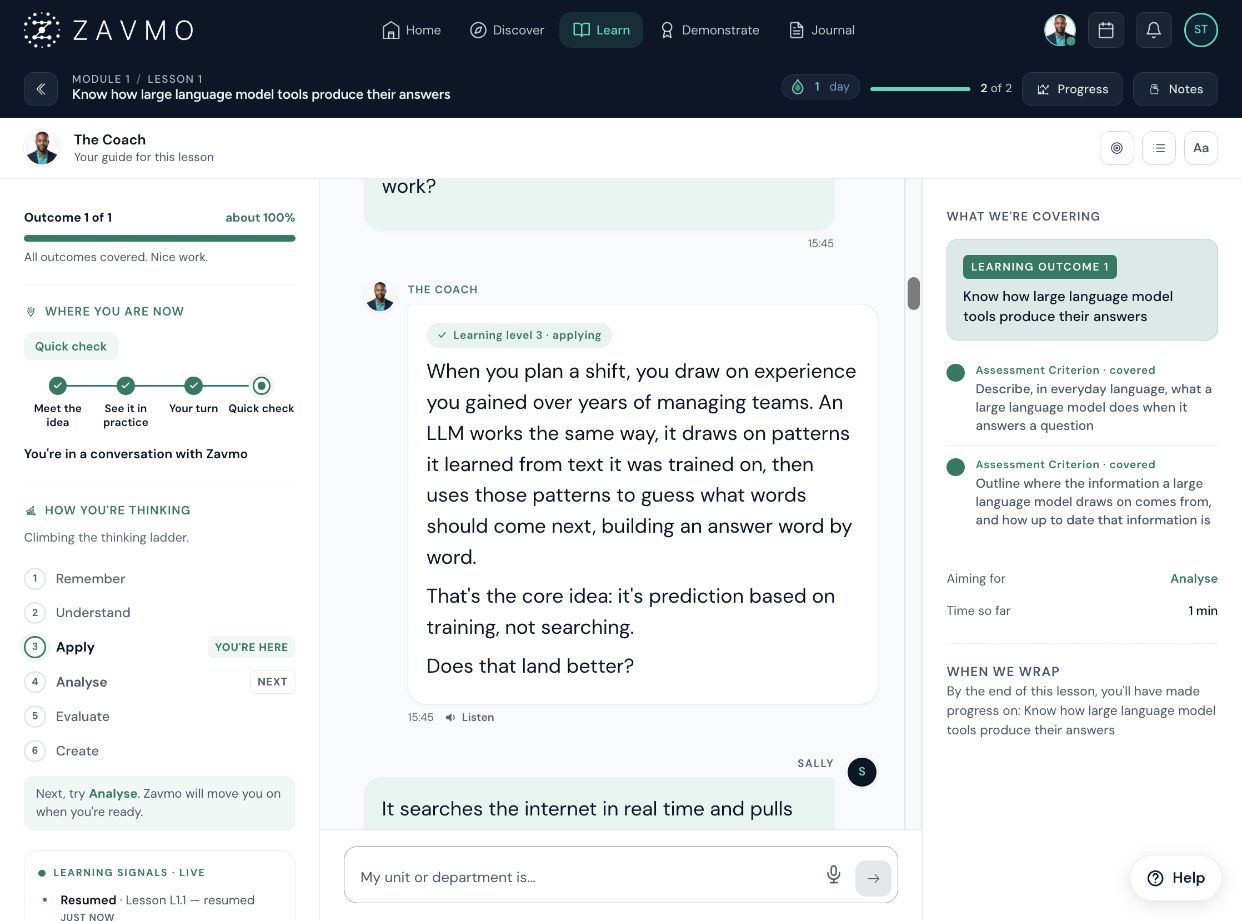
That is a real lesson. The first explanation did not land, so the tutor tried again with shift planning, something the learner knew from managing a team. Then it asked whether that was better.
I have wanted that for every learner since I started. Now it exists.
What that means if you want in
The job is moving. Making content matters less. Knowing what good learning looks like, and proving something changed, matters more.
If you come into L&D to make slides, that part of the work is shrinking. If you come in to help people actually get better at their jobs, you have picked a brilliant time.
A small next step
Look at real learning and development job descriptions and put one next to your own job. I wrote about how to use a job description to plan your next move. You can also browse teaching and training qualifications.
And learn to use AI in your own work first. Every L&D team will need someone who has done it. Your first Future Fluency module is free.