Juliette's Learning Tribe
Is a Level 5 diploma worth it if you already have a job?
A Level 5 diploma sits beside a foundation degree or HND, one step below a degree. When it is worth it, when it is not, and how to check one.
A Level 5 diploma is worth it if the job you want next asks for it. It helps even more if you can do the work for it inside the job you have. It is not a degree. It sits at the same level as a foundation degree or an HND, one step below a bachelor’s degree with honours.
So the useful question is not “is Level 5 good?” It is “good for what?”
What a Level 5 diploma is equal to
The government keeps a plain list of what qualification levels mean. At Level 5 it puts the foundation degree, the higher national diploma (HND), the diploma of higher education, and Level 5 awards, certificates and diplomas.
A degree with honours, a BA or a BSc, is Level 6.
So a Level 5 diploma is not equivalent to a degree. It is a rung below. If a job advert says “degree or equivalent”, ask the employer whether they would count it. Some will. Do not assume.
Same level, very different sizes
This is the part that catches people out.
The level tells you how hard the work is. It does not tell you how much of it there is. The same gov.uk guide says it plainly: qualifications at the same level sometimes cover different amounts of the same subject.
Here is a real one. The CIPD Level 5 Associate Diploma in Organisational Learning and Development is listed at 420 hours in total, with 175 of those taught. That is about eight hours a week for a year. Another “Level 5 diploma” in a different subject could be a fraction of that, or a lot more.
Levels are easy to get wrong. In August we found most of the levels on our own job descriptions were set too high, because of one wrong number in one file. We rebuilt them. If we can get it wrong with a database in front of us, a course advert can too.
When it is worth it
- The job you want asks for it. Read five adverts for the role you are aiming at. If the same qualification keeps turning up, that is your answer.
- A professional body is behind it. In HR and learning, for example, CIPD qualifications come with CIPD membership. You have to be a member the whole time you study.
- Your own job can be the evidence. Some Level 5 diplomas are assessed on coursework and real work, not exams. The CIPD one above lists coursework, a portfolio and practical assignments. If you already have a job, that is a gift. You learn on Monday and use it on Tuesday.
- Your employer will pay or give you time. Then the cost is mostly your evenings. I have written about how to ask your employer to pay, with an email you can send.
When it is not
The job you want needs a degree, a licence or a registration, and Level 5 does not get you there. Check this first. It saves a year.
You want it to feel qualified. I understand that one completely. But a certificate proves you passed the assessment. It does not prove anything changed in your work. Employers who are hiring want to hear what changed.
It is a course that calls itself “Level 5 equivalent” and is not on the register. Equivalent to what? If it is not listed, nobody regulated it.
How to check a specific one
Before you pay a penny, look it up on Ofqual’s Find a regulated qualification. Search by name or by the qualification number the provider gives you.
Then check five things on its page.
- The level. Is it really Level 5?
- Total qualification time. This is the real size of it, in hours.
- The awarding organisation. That is who actually awards it. The college or website selling it may be someone else.
- The status. You want “Available to learners”.
- How it is assessed. Coursework, portfolio, exams. Pick the one that suits how you work.
Then ask about money. As of November 2026, an Advanced Learner Loan can cover Level 3 to 6 courses. You need to be 19 or over, at an approved college or provider in England. For a Level 4, 5 or 6 course starting on or after 1 January 2027, gov.uk says to apply through the Lifelong Learning Entitlement instead. Ask the provider which one applies to you before you sign anything.
For more on choosing, I have written up which qualification is actually worth your time.
Where Zavmo fits
We are not an awarding body and we are not a centre. We do not award Level 5 diplomas, or anything else. The awarding organisation does that, through a centre it has approved.
What we do is the part in between. You can look through Level 5 qualifications and see what each one covers. Then your AI tutor builds a plan from the units and teaches you on your real work, one short session at a time.
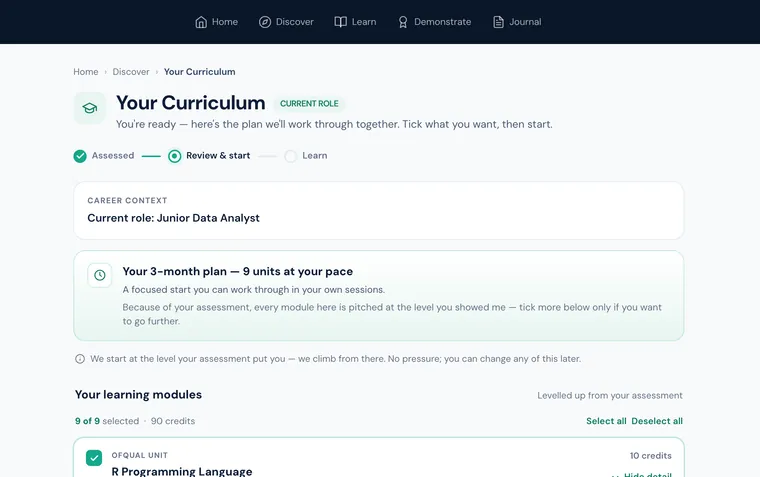
For most of my career, a plan built around one person’s actual job needed a tutor nobody could pay for. Now it is the easy part. I still find that astonishing.
You still sit the assessment with the awarding body’s approved centre. We help you arrive ready for it. There is more on how qualifications work with Zavmo.
A small next step
Start with the job, not the course. Check what level your job is now and where it leads next. Then you will know whether Level 5 is the step up, or a step sideways.