
Cambridge OCRRQF Level 3
Cambridge OCR Level 3 Cambridge Technical Diploma in Engineering
Zavmo teaches it and the awarding body awards it. You practise each unit one-to-one, on your own real work.
- Units Listed
- 23
- Qualification Reference
- 601/4599/7
The Course Content. Taught Through Your World.
How Zavmo Teaches This Course to You
Bring your role, your experience and the questions you face. Explore the course through examples that mean something to you.
Bring a Question From Your Work
A Familiar Starting Point.
A project. A budget. A conversation you need to prepare. See how familiar situations can make a new idea clearer.
The examples shape the teaching. The course requirements stay the same.
From the Product
An Explanation Connected to Your Work
In this test lesson, the learner asked for an explanation using shift planning. The tutor responded through that familiar situation.
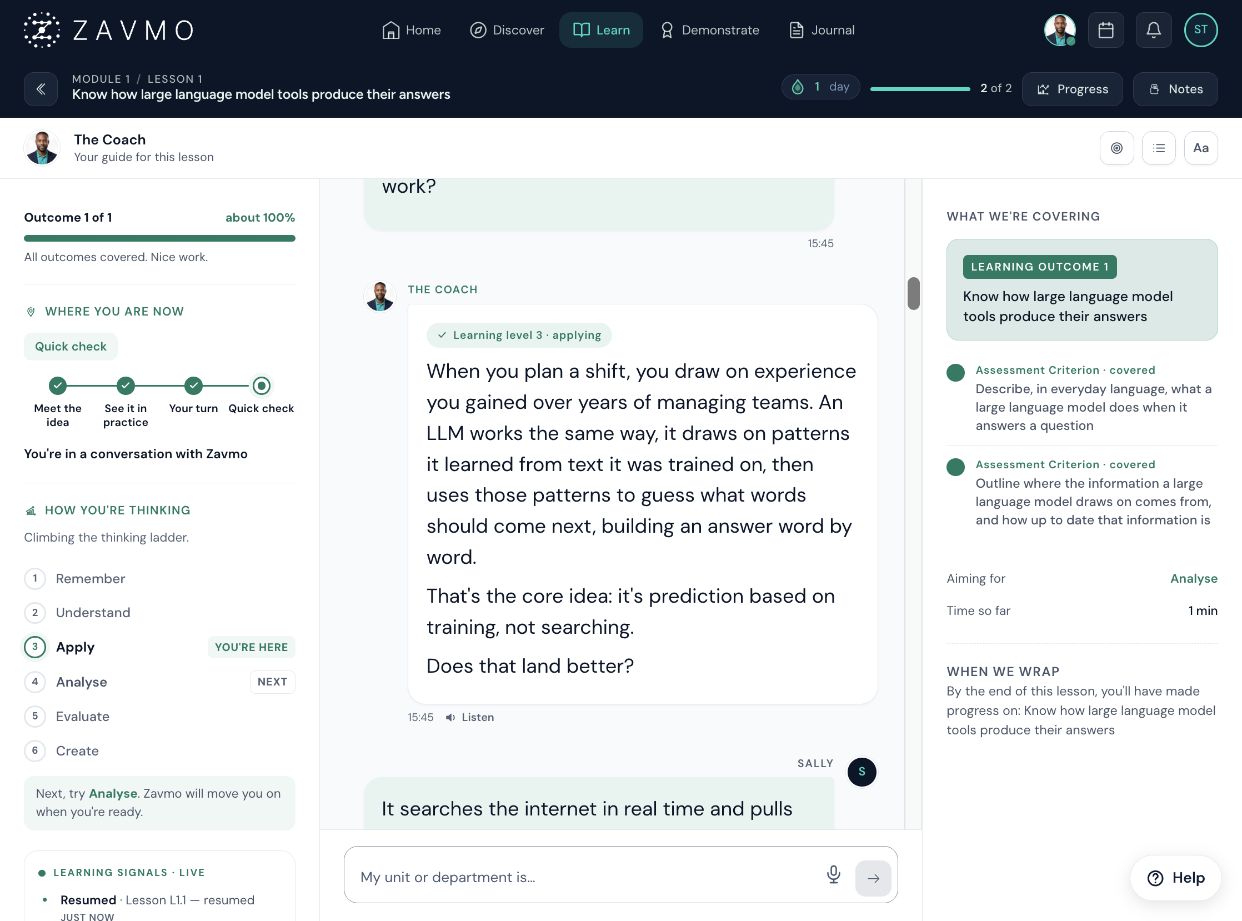
- 01 · Start With You
Your role, existing knowledge and the situation you want to understand.
- 02 · Work Through It
Ask for another explanation. Explore an example. Explain your reasoning.
- 03 · Practise the Outcome
Use what you have learnt in a relevant task, with the course outcome kept in view.
Your examples shape the teaching. They do not change the awarding body’s requirements. Use anonymised or fictional details for client situations.
How You Would Get This Certificate
- Zavmo teaches you. You learn the units one-to-one with an AI tutor, on your own work.
- You register with an approved centre. That is a college, training provider or employer Cambridge OCR has approved to offer this qualification. Zavmo is not an approved centre, so you register with them, not with us.
- The centre assesses, and Cambridge OCR awards. A qualified assessor at the centre judges your evidence, and the certificate comes from Cambridge OCR.
The Level 3 Cambridge Technical Diploma in Engineering allows learners to specialise within the engineering sector. It covers mathematics and science for engineering, alongside mechanical, electrical and electronic engineering principles. This qualification is suited to those seeking further study or employment in engineering.
These are the units Cambridge OCR registers against this qualification. It is a catalogue, not a syllabus. Which of them you take depends on the combination the qualification requires, and that is set by the awarding body rather than by us. Every unit here is regulated. Zavmo teaches towards them on your own work.
Zavmo is not an awarding body, is not an approved centre, and is not affiliated with Cambridge OCR. It does the teaching and the mapping. Cambridge OCR sets this qualification and awards it, and a qualified human assessor makes the assessment decision.
What You Will Learn in Each Unit
Applied mathematics for engineering Real unit · Cambridge OCR
What you'll be able to do
- Apply algebraic techniques to solve engineering problems
- Utilise trigonometric functions and identities in engineering calculations
- Apply calculus principles to analyse engineering systems
- Use statistical methods to interpret engineering data
- Apply mathematical modelling techniques to simulate engineering scenarios
- Solve differential equations relevant to engineering applications
- Understand the use of matrices and vectors in engineering analysis
Automation control and robotics Real unit · Cambridge OCR
What you'll be able to do
- Understand the principles of automation control systems
- Understand the principles of robotics
- Identify the components of automation control and robotic systems
- Program and operate automated control systems
- Program and operate robotic systems
- Integrate automation control and robotic systems
- Troubleshoot and maintain automation control and robotic systems
- Evaluate the performance of automation control and robotic systems
Business for engineering Real unit · Cambridge OCR
What you'll be able to do
- Understand the role of businesses within the engineering sector
- Identify different types of business structures commonly found in engineering
- Analyse the financial aspects of running an engineering business, including costs, revenue, and profit
- Understand the importance of marketing and sales in the engineering industry
- Investigate the legal and ethical considerations relevant to engineering businesses
- Explore the impact of economic factors on engineering businesses
- Understand the principles of project management within an engineering business context
Circuit simulation and manufacture Real unit · Cambridge OCR
What you'll be able to do
- Understand the principles of circuit simulation software
- Use circuit simulation software to model and analyse electronic circuits
- Interpret simulation results and identify potential circuit issues
- Understand different manufacturing techniques for electronic circuits
- Apply soldering and other assembly techniques to manufacture electronic circuits
- Test and troubleshoot manufactured circuits
- Understand the importance of safety procedures in circuit simulation and manufacture
Computer Aided Design (CAD) Real unit · Cambridge OCR
What you'll be able to do
- Understand the principles of Computer Aided Design (CAD)
- Use CAD software to create 2D and 3D models
- Apply CAD techniques to design engineering components
- Analyse and modify existing CAD designs
- Produce technical drawings and documentation using CAD software
Computer Aided Manufacturing (CAM) Real unit · Cambridge OCR
What you'll be able to do
- Understand the principles of Computer Aided Manufacturing (CAM)
- Use CAM software to generate toolpaths for manufacturing processes
- Apply CAM techniques to optimise manufacturing efficiency
- Analyse and modify existing CAM programs
- Produce manufacturing documentation using CAM software
Electrical and electronic design Real unit · Cambridge OCR
What you'll be able to do
- Understand the fundamental principles of electrical and electronic design
- Apply design principles to create electrical and electronic circuits
- Analyse the performance of electrical and electronic designs
- Evaluate the suitability of components for specific electrical and electronic applications
- Produce detailed documentation for electrical and electronic designs
Electrical devices Real unit · Cambridge OCR
What you'll be able to do
- Understand the characteristics and applications of various electrical devices
- Identify different types of resistors, capacitors, and inductors
- Analyse the behaviour of diodes and transistors in electronic circuits
- Understand the principles of operation of transformers and motors
- Apply appropriate measurement techniques to assess the performance of electrical devices
- Troubleshoot common faults in electrical devices
- Understand the safety considerations when working with electrical devices
Electrical operations Real unit · Cambridge OCR
What you'll be able to do
- Understand the fundamental principles of electrical operations
- Demonstrate safe working practices when undertaking electrical operations
- Apply appropriate techniques for carrying out electrical operations
- Interpret electrical circuit diagrams and technical specifications
- Inspect and test electrical systems and components
- Diagnose faults in electrical systems and equipment
- Carry out repairs and maintenance on electrical systems and equipment
- Document electrical operations and maintenance activities
Electrical, mechanical, hydraulic and pneumatic control Real unit · Cambridge OCR
What you'll be able to do
- Understand the principles of electrical control systems
- Understand the principles of mechanical control systems
- Understand the principles of hydraulic control systems
- Understand the principles of pneumatic control systems
- Identify the components of electrical, mechanical, hydraulic and pneumatic control systems
- Integrate electrical, mechanical, hydraulic and pneumatic control systems
- Troubleshoot and maintain electrical, mechanical, hydraulic and pneumatic control systems
- Evaluate the performance of integrated control systems
Engineering and the environment Real unit · Cambridge OCR
What you'll be able to do
- Understand the environmental impact of engineering activities
- Identify relevant environmental legislation and regulations affecting engineering projects
- Evaluate sustainable engineering practices and technologies
- Analyse the principles of waste management and pollution control in engineering
- Understand the importance of environmental impact assessments
- Explore the role of engineers in promoting environmental sustainability
- Investigate the use of renewable energy sources in engineering applications
Inspection and testing Real unit · Cambridge OCR
What you'll be able to do
- Understand the principles of inspection and testing in engineering
- Understand different types of inspection and testing methods
- Apply inspection techniques to identify defects and non-conformities
- Conduct testing procedures to verify product and system performance
- Evaluate the results of inspection and testing activities
Lean and quality Real unit · Cambridge OCR
What you'll be able to do
- Understand the principles of lean manufacturing and its application in engineering
- Understand the importance of quality control in engineering processes
- Apply lean techniques to improve efficiency and reduce waste
- Implement quality control measures to ensure product and process reliability
- Evaluate the effectiveness of lean and quality initiatives
Maintenance Real unit · Cambridge OCR
What you'll be able to do
- Understand the principles of maintenance in engineering systems
- Understand different types of maintenance strategies, including preventative and reactive maintenance
- Apply maintenance procedures to ensure the continued operation of equipment and systems
- Diagnose faults and perform repairs on engineering equipment
- Evaluate the effectiveness of maintenance programmes
Materials science Real unit · Cambridge OCR
What you'll be able to do
- Understand the fundamental principles of materials science
- Identify and classify different types of engineering materials
- Analyse the properties of materials and their behaviour under different conditions
- Evaluate the suitability of materials for specific engineering applications
- Understand the impact of material selection on design performance
Mathematics for engineering Real unit · Cambridge OCR
What you'll be able to do
- Apply mathematical principles to solve engineering problems
- Use algebraic techniques to manipulate and solve equations relevant to engineering
- Apply trigonometric principles to engineering calculations
- Use statistical methods to analyse engineering data
- Apply calculus to solve engineering problems
- Interpret and present mathematical data in engineering contexts
Mechanical design Real unit · Cambridge OCR
What you'll be able to do
- Understand the fundamental principles of mechanical design
- Apply design principles to create mechanical components and systems
- Analyse the performance of mechanical designs
- Evaluate the suitability of materials for specific mechanical applications
- Produce detailed documentation for mechanical designs
Mechanical operations Real unit · Cambridge OCR
What you'll be able to do
- Understand the fundamental principles of mechanical operations
- Demonstrate safe working practices when undertaking mechanical operations
- Apply appropriate techniques for carrying out mechanical operations
- Interpret mechanical engineering drawings and technical specifications
- Inspect and test mechanical systems and components
- Diagnose faults in mechanical systems and equipment
- Carry out repairs and maintenance on mechanical systems and equipment
- Document mechanical operations and maintenance activities
Mechanical simulation and modelling Real unit · Cambridge OCR
What you'll be able to do
- Understand the principles of mechanical simulation and modelling
- Apply appropriate software tools for mechanical simulation and modelling
- Develop mechanical models based on given specifications
- Analyse the results of mechanical simulations
- Validate mechanical models against real-world data
- Interpret and present the findings of mechanical simulation and modelling activities
- Evaluate the accuracy and limitations of mechanical simulation and modelling techniques
- Apply mechanical simulation and modelling to solve engineering problems
Principles of electrical and electronic engineering Real unit · Cambridge OCR
What you'll be able to do
- Understand fundamental principles of electrical engineering
- Understand fundamental principles of electronic engineering
- Analyse electrical circuits using appropriate techniques
- Analyse electronic circuits using appropriate techniques
- Understand the characteristics of electrical and electronic components
- Apply principles of electrical and electronic engineering to solve practical problems
Principles of mechanical engineering Real unit · Cambridge OCR
What you'll be able to do
- Understand fundamental principles of mechanical engineering
- Apply principles of statics and dynamics to analyse mechanical systems
- Analyse the behaviour of materials under stress and strain
- Understand the principles of thermodynamics and fluid mechanics
- Apply principles of mechanical design to solve engineering problems
- Evaluate the performance of mechanical systems
Science for engineering Real unit · Cambridge OCR
What you'll be able to do
- Understand fundamental scientific principles relevant to engineering
- Apply scientific principles to analyse engineering systems and processes
- Investigate the properties of materials used in engineering applications
- Understand the principles of energy transfer and conservation
- Apply scientific measurement techniques to engineering problems
- Evaluate the impact of scientific advancements on engineering practices
Systems and programming Real unit · Cambridge OCR
What you'll be able to do
- Understand the fundamental concepts of systems in an engineering context
- Understand the principles of programming and software development
- Apply programming techniques to solve engineering problems
- Analyse the interaction between hardware and software systems
- Evaluate the performance of different programming solutions
Free, by email
Is this the right qualification for you?
One email to help you decide: the facts, what it teaches, the jobs it leads to and where to start free. With a link back here. Nothing else follows unless you confirm your address.
Juliette Denny, Zavmo's founder, writes about learning and work on LinkedIn. Follow Juliette's Learning Tribe
Study the units online with a personal AI tutor, for £70 a month. Your first Future Fluency module is free.
The Standards Behind These Units
What the job actually needs, in the words employers and awarding bodies already use for the work itself.
- Standard
Carry out Computer Modelling and Simulation of a Biomanufacturing Process
- Standard
Inspecting engineering products by thermography testing
Roles Related to This Qualification
A qualification is never a dead end here. Each of these is a job record this qualification is a mapped route into.
- 1 record
- 1 record
- 1 record
- 1 record
- 1 record
- 1 record
Showing 6 roles, drawn from 46 job records mapped to this qualification. Near-identical records are folded together, and each row says how many it stands for.
Where this can lead
Maintenance Technician
This work can lead to supervising other technicians, or managing maintenance and engineering across whole buildings or portfolios.
See the whole journeyOne email to help you decide: the facts, what it teaches, the jobs it leads to and where to start free. With a link back here. Nothing else follows unless you confirm your address.
Your Credits and Who Awards Them
Cambridge OCR awards the credits. Your Zavmo record shows what you have covered and what to work on next.
What you would be collecting
Applied mathematics for engineeringAutomation control and roboticsBusiness for engineeringCircuit simulation and manufactureComputer Aided Design (CAD)Computer Aided Manufacturing (CAM)Electrical and electronic designElectrical devices
Each one is a real unit registered against this qualification.
How you’d practise it
Practise What You Learn
With Zavmo, you practise using what you learn. Work through a task, explain your reasoning and review it with your AI tutor. Your approved centre decides how the qualification is assessed.
 The Analyst · your map-it-properly tutor Illustration
- Map a live decision Analyse
For “Lean and quality”, choose a decision to work through. Map the options, question your assumptions and consider what could happen next.
Learning That Starts With You
Learn One to One, Through Your Own Work
Work through practical tasks with your AI tutor. You explain your choices, try things out and learn at your pace.
A lesson from Applied mathematics for engineering, one of this qualification's own units.
Applied to your work in any of these jobs
This unit enables learners to apply mathematical techniques to engineering problems. Learners will use algebra, trigonometry, calculus, statistics, and mathematical modelling to analyse and simulate engineering systems.
- 1 Remember
- 2 Understand
- 3 Apply
- 4 Analyse
- 5 Evaluate
- 6 Create
It is £70 a month, billed monthly. Your free first module is Future Fluency, and you can cancel any time. Teaching towards this qualification begins when you subscribe.
Built for Cambridge OCR Level 3 Cambridge Technical Diploma in Engineering
23 units listed for this qualification. Check Cambridge OCR for the required combination.
- Applied mathematics for engineering
- Automation control and robotics
- Business for engineering
- Circuit simulation and manufacture
- Computer Aided Design (CAD)
- Computer Aided Manufacturing (CAM)
and 17 more in the full unit list.
Free tools
Find Your Next Step
Try a free check to see where you stand. No account needed.
See How You Will Learn
How Zavmo Teaches You
A real test lesson, with questions and practice connected to the learner’s work.
The Practical Arrangements
Teaching and the Qualification
Search and plan for free. Your first Future Fluency module is free. Further teaching is £70 a month, billed monthly. Cancel any time.
Zavmo is not the awarding body or an approved centre. Formal registration, assessment and certification are separate arrangements.
Check the awarding body’s current requirements before committing to a qualification route.
Built Around You
Your Next Step
Keep Cambridge OCR Level 3 Cambridge Technical Diploma in Engineering in view as you choose your learning. Create your free account and try a Future Fluency module before deciding whether to pay.
Continue With This CourseThis qualification is separate from the free Future Fluency module. No card needed for that module.
The title, level, credits, guided learning hours and unit learning outcomes on this page are taken from the Ofqual Register of Regulated Qualifications. Contains public sector information licensed under the Open Government Licence v3.0. Where this data comes from.
From the Blog
Read More
- Which qualification is actually worth your time Before you sign up for anything, read this. How to tell which qualification gets you the job you want, and which just costs you months you will not get back.
- How to ask your employer to pay for training (email to copy) Ask in writing, keep it short and make it about the work. A plain email you can copy, plus your legal right to request time off to train in the UK.
